Showing posts with label concrete. Show all posts

Monday, March 10, 2014

Week 9 - SIPs wall panels are here!

img-alternative-text

I got a text on Friday from my trusted neighbor-spy Jesse saying "SIPs just rolled in!" I was out of town, but on Sunday I got to check them out — notice the stacked, thick white panels sitting on the ground. Also, the tent for the concrete came down, so I got to check out the concrete in the full sunlight. It looks good — a huge relief!

SIPs are awesome!

image-2363

The image above shows a stack of five Structural Insulated Panels (SIPs), soon to be lifted by a crane and installed as the walls of the building. I mentioned SIPs in my overview post a while back, but let me tell you a little bit more about why these types of walls are such an important part of energy efficient design.

Why make walls in a factory?

img-alternative-text

Youve probably seen a traditionally framed wall at a construction site, a web of 2 x 4 or 2 x 6 lumber going in every direction. Long horizontal boards, called plates, are placed along the top and bottom of the wall, vertical boards, called studs, run the height of the wall and little horizontal pieces, called nogging, are placed in between the studs. You have to be careful to lay out everything so that the window and door openings are taken into account and adequately reinforced. Plywood goes on the outside once the lumber is in place.

img-alternative-text

On the other hand, our SIPs walls are fabricated in a factory in Vermont. The panels are huge, consisting of a single 8 inch thick slab of EPS foam sandwiched between two long pieces of oriented strand boards (OSB), and measuring 4 feet wide and two stories tall. The foam and OSB are held together with urethane glue.

Fabricating the panels in an indoor setting adds a number of advantages: automated machinery cuts and laminates the panels quickly and precisely without generating much waste; the shape and layout of the panels are digitally uploaded to the manufacturing equipment without the need to interpret drawings onsite; the quality of the panels can be tightly controlled and verified before shipping; and construction times are shorter because the panels can be made while the foundation is being constructed.

The end result is a monolithic panel that is airtight and super-insulated. The panels interlock, but you still have to seal the edges with tape. Although some builders use only the panels themselves as the walls, we will be adding 2 x 6 interior wall studs and blown-in fiberglass insulation to increase the R value of the walls and to provide space for electrical wiring.

youtube

In the video above, Matt OMalia describes the process of installing the SIPs at the GO Home.

Concrete floor looks great!

img-alternative-text

After a worrying about the concrete floor last week, I was excited to see how the surface of the concrete turned out. I think it looks great – it has a nice matt finish to it, some interesting texture and the color is pleasing. I guess it will add more of an industrial feel to the home rather than a fancy shiny granite look, which is cool — maybe even better than a polish.

This is better than polished concrete

There appear to be multiple definitions of "polished" concrete. The architect and builder told me that the actual grinding part of the polish – the part that gives it its mirror like shine – wasnt planned for, or included in the price. That step can be done later, if desired, but it would add a substantial amount to the cost of the floor. In the end, I think the builder went with the best of all possible options. Its the economical option because the expensive grinding process was omitted. Its the healthy option because we didnt use a chemical sealer. Plus, its the durable option because we used a densifier to harden the concrete.

img-alternative-text

The image above is a closeup of the concrete control joint, a cut in the concrete that promotes cracking underneath the joint, instead of along the surface. You can also get a better sense for the texture of the surface — its pretty smooth to the touch. Im not sure what part of the texture will wipe off when its cleaned, but Im feeling good about it, regardless.

Backfilled around the perimeter
img-alternative-text

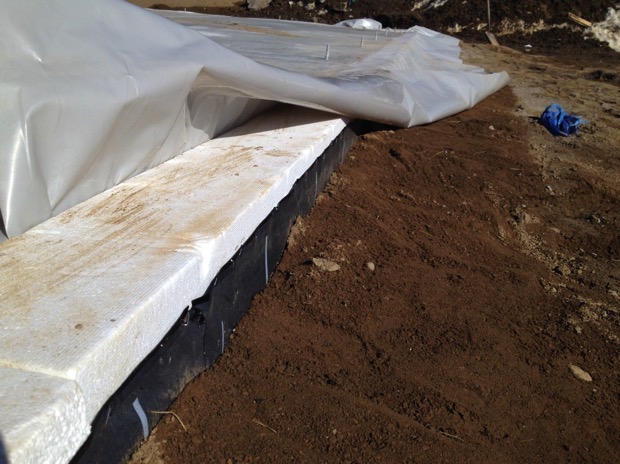
Heres an image of the EPS foam, having been lined with a black covering — the ice and water shield — and backfilled with dirt. Buried under the dirt is another EPS panel, a "wing" that serves to insulate the ground under the wing from frost. The gray plastic is the poly vapor barrier that forms a continuous seal underneath the concrete.

Sunday, March 2, 2014

Week 8 - Concrete poured, beaver lodge located

img-alternative-text

Suddenly, we have made major progress this week, despite the continued frigid temperatures! On Monday, the rebar was set into place and on Tuesday the concrete was poured. Everything seems to be going well, but not without some misunderstanding. Also, I think Ive finally located the beaver lodge.

Pouring the concrete

image-9

When I showed up, the first concrete truck had just finished pouring its portion of the concrete and the guys were spreading out the concrete and leveling it. The second truck was on it’s way, but I had to take off.

Power troweling the concrete all night

img-alternative-text

Later that night, I dropped in to find the concrete guy floating the concrete, using the power troweler on the right. After waiting for the concrete to cure until it was hard enough to walk on, he repeatedly ran the power troweler over the concrete until he was satisfied with the sheen. The process apparently took all night — it had to be done before the concrete hardened any further. Hopefully, the neighbors weren’t bothered by the sound of the generator.

img-alternative-text

Here’s the floor in the morning. It looks smoother, but what’s all that white stuff?

Is this polished concrete?

The concrete process seems to be deviating from what I expected, and I’m not exactly sure what is going on. We had decided on polished concrete floors — an agonizing decision because of a the $5/sq ft premium over traditional concrete, with a total cost of $15.6/sq ft. For comparison, $14/sq ft is the cost of a high-end wood floor. The concrete doubles as the foundation, so it’s not a fair comparison, but still — it’s not cheap.

Polished concrete has the advantage that it does not require chemical sealers or annual waxing, and apparently the look is better. As I understood it, the process for polished concrete follows these steps:

  1. Once the concrete hardens, it is ground down to a smooth finish, exposing the aggregates in the concrete.
  2. A densifier is applied to the concrete to harden it, providing a hard surface that does not need maintenance. The densifier is a non-toxic mixture of silicic acid, potassium salt and water that reacts with the concrete to produce calcium silicate hydrate, a super-strong material.
  3. The hardened concrete is ground down to a progressively finer finish until the desired polish is achieved.

It looks like the concrete guy is actually going down a much different route, which might end up fine, but I’m worried about getting a floor that looks like a basement rather than something that suits a living room. One aspect that concerns me is the troweling process, described above. Apparently this process buries the aggregates under the surface of the concrete, giving a more homogenous appearance that is typical of a concrete floor. But the texture that the aggregates provide seems to be partly what makes polished concrete look so good. I’m crossing my fingers that it will turn out OK. I’m also wondering where the $5/sq ft premium went.

img-alternative-text

On Friday, after a couple of days of curing, the densifier was applied. I’m hoping that those scuff marks are not permanently engrained in the concrete. I guess there’s no turning back now.

img-alternative-text

Here’s one of the two massive propane burners, running 24/7 for a week now to keep the concrete warm.

Did I find the beaver lodge?

img-alternative-text

To relieve my worry about the concrete floor, I decided to go check on the beavers. I think I found their lodge, but I’m bothered by the fact that it is so close to the trail — it seems like I would have seen it earlier. Notice the pile of sticks covered in snow, right at the center of the photo. It could be a random pile of sticks, but the location makes me think it is a lodge. Look at how the lodge is situated right at the crux of the stream’s oxbow — this is exactly the same positioning as an abandoned beaver lodge further down stream. My guess is that theyve installed two entryways, one downstream and one upstream.

img-alternative-text

The beaver dam is still holding up well. This most extensive dam in the area. Starting from the lower right side of the image, the dam runs diagonally and then continues to zig zig into the distance, making its way to the hillside that you can see in the background — a massive work of engineering.

Monday, February 24, 2014

Weeks 6 & 7 - Getting ready for the concrete

Week 6 brought more snow

Cold temperatures and endless snow made it impossible to get any work done in week 6. It’s hard to believe how wintery this winter has been, especially since the fall was so warm. Now the project is buried deep in snow, seemingly halted indefinitely.

Week 7 - a tent for the concrete

Wow! The builders saw an opening in the weather and scrambled to put up a tent. Check out the major snow removal operation they pulled off. We must have had an accumulation of at least two feet of dense wet snow, yet they somehow shoveled all that snow off of the EPS foam and also plowed extensively around the perimeter.

The purpose of the tent is to keep the concrete warm enough so that it can solidify and be polished, and to protect it from the elements. The polishing process is done under water (to protect the crew from harmful dust particles), so the temperature must be kept well above freezing. You can see a large propane tank off to the right. We’re probably using more energy to keep that tent warm than will be used by the home for many years. Hopefully, everything will go smoothly with the concrete and it will be done soon.

Here’s what it looks like inside the tent. The structural fill has just been compacted, burying the plumbing, conduits and radon mitigation piping. Now, rebar must be installed prior to pouring the concrete, which should happen tomorrow.