Showing posts with label roof eave. Show all posts

Wednesday, April 23, 2014

Week 15 - Roof is up, working on window framing

The week involved finishing the roof sheathing, working on the window frames and building a temporary staircase. Things are starting to get detailed, and are taking more time. Below, I’ll show how the windows are framed since the process appears to be non-standard (and important).

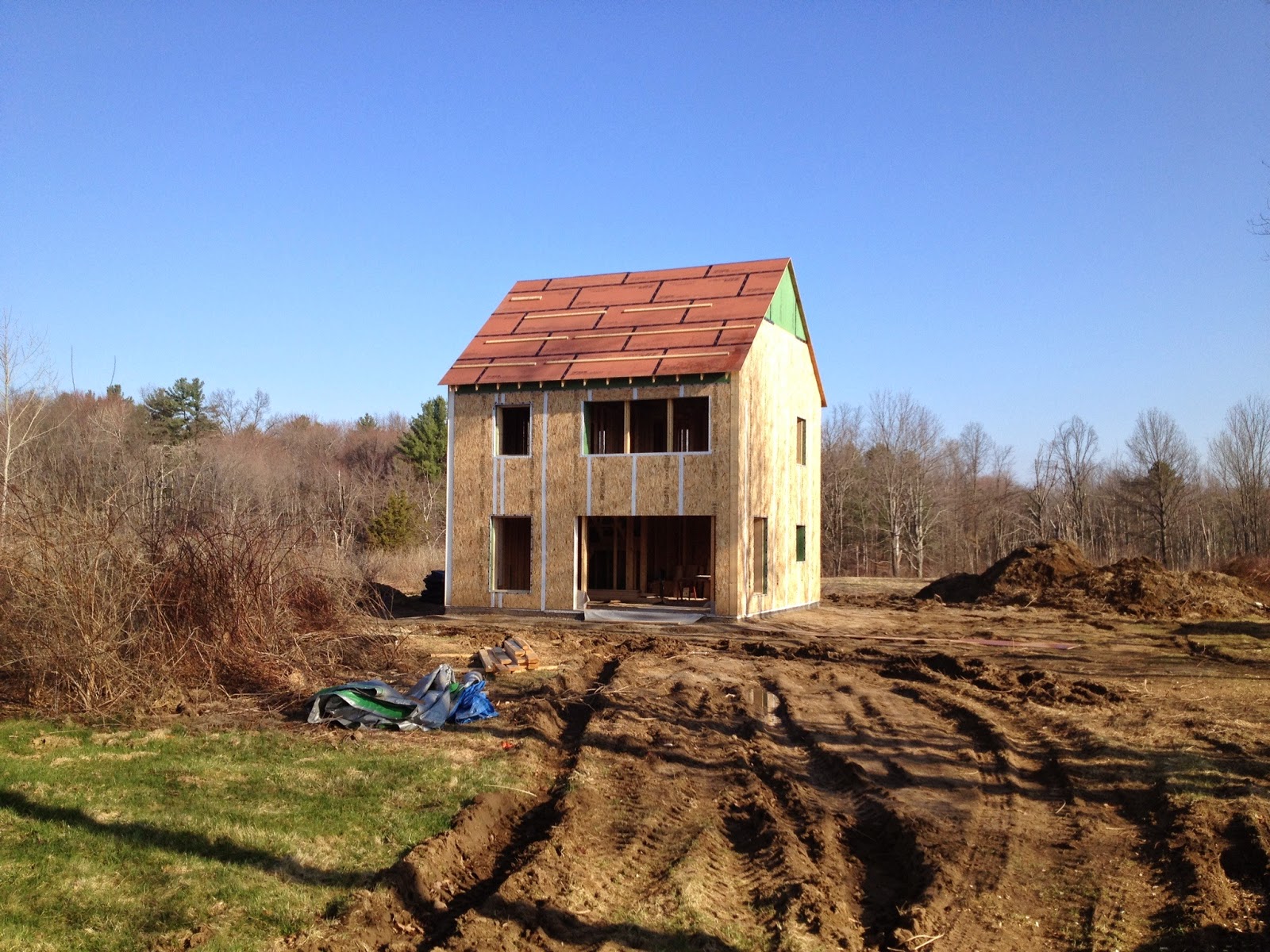
Roof almost done before the snow

Don almost had the roof complete before the wind picked up and nearly blew him off (according to how he tells it). The next day, the rain and snow ended up getting everywhere. Above, a little bit of snow is still left on the roof after the storm. I love this shot of the back of the house from the apple orchard. As architect Todd said: “the house sits nicely on the land.”

A look at the scissor roof trusses

Here’s a cool shot of the scissor trusses. ZIP panels will be attached to the underside, forming the air barrier as well as the gabled ceiling of the two front rooms. Almost 2 feet of blown-in cellulose insulation will go on top of the ZIP panels, outside the airtight envelope. There is some reduction in the insulating ability of the cellulose due to the fact that cold air will be able to move through the insulation, but the advantage is that moisture will not get trapped.

The roof truss at the eave sits on the ZIP air barrier. The ZIP will continue along the scissor truss. Notice how the floor joists are angled to accommodate the ZIP and drywall.

It takes time to frame these windows

Normally, the window framing would be complete at this point (except the sill is missing in the image above). With our construction, the window frame spans two walls: the SIP wall and the stud wall, so there’s quite a bit more to do. The two walls must be bridged in a way that is airtight and moisture repellent. Don and a helper spent much of the week finishing the extra steps to frame the windows, and reported that the process was somewhat elaborate and time consuming.

First, if you look closely at the SIP part of the frame, you’ll see a gap between exterior OSB panel and the foam insulation. That gap is meant to allow 2 x 2 wood pieces to be wedged there, to provide somewhere to nail the rest of the framing to the SIP.

Next, the green ZIP sheathing is nailed to the frame, bridging the two walls. Caulking is applied under the ZIP to prevent water and air from migrating horizontally.

2 x 10 boards are nailed to the ZIP to provide a solid wood frame, to which the window can be attached. Again, caulking is applied under the boards.

The entire window frame has the appearance of being over-engineered — it’s three boards thick in some places. I wonder if this bomb-proof structure is by design — to reduce load stresses and sheer stress from the windows — or if it’s just a function of having to deal with the SIP wall and stud wall discontinuity. As you might imagine, measuring all these boards, caulking and nailing takes a substantial amount of time.

But we’re not finished. Outside (1st floor window pictured here), the SIP is affixed to the interior window frame with gigantically long screws, and then tape is applied where the ZIP meets the SIP. As far as I can tell, this location — the outside of the SIP — is the primary air barrier. The window will sit right on the edge of the innermost 2 x 10 boards.

Sunday, April 13, 2014

Week 14 - Starting to look like a house

The walls are in place and the roof trusses are up. Don and crew are now working on the roof ZIP sheathing. It’s starting the come together and look like a house! The weather has been amazing, and that might be a big reason why so much got done this week.

Using the lull to raise the SIP walls

The ground dried up enough so that Don could maneuver the lull through the mud, allowing him to raise the SIPs on the east and west sides. These panels are considerable bigger than those on the north and south sides. It would have been difficult to lift them by hand, so we really lucked out.

The movie shows the lull lifting the SIP, with a rope used to stabilize the SIP. Notice how the SIP starts to slip off the fork, and then the guys on the roof were able to pull it back into place, but not before having to walk out on the headers like acrobats. They are fearless. Keep in mind that there’s no floor under them – they are balancing on the header beams, and on one side there’s a two story drop!

Once the lull got the SIP most of the way up, the guys on the roof were able to pull it upright against the house.

To help lift the panel onto the foundation ledge by hand, a little plastic handle came in handy.

Sliding these large panels over was difficult, so the lull was used to push them in place. For some reason, the panels on this side came out bowed and it was tough to get them to interlock. Using the lull to push on the panel, the guys banged furiously on the seam, gradually jostling the two panels together.

Update on the views from the windows out back

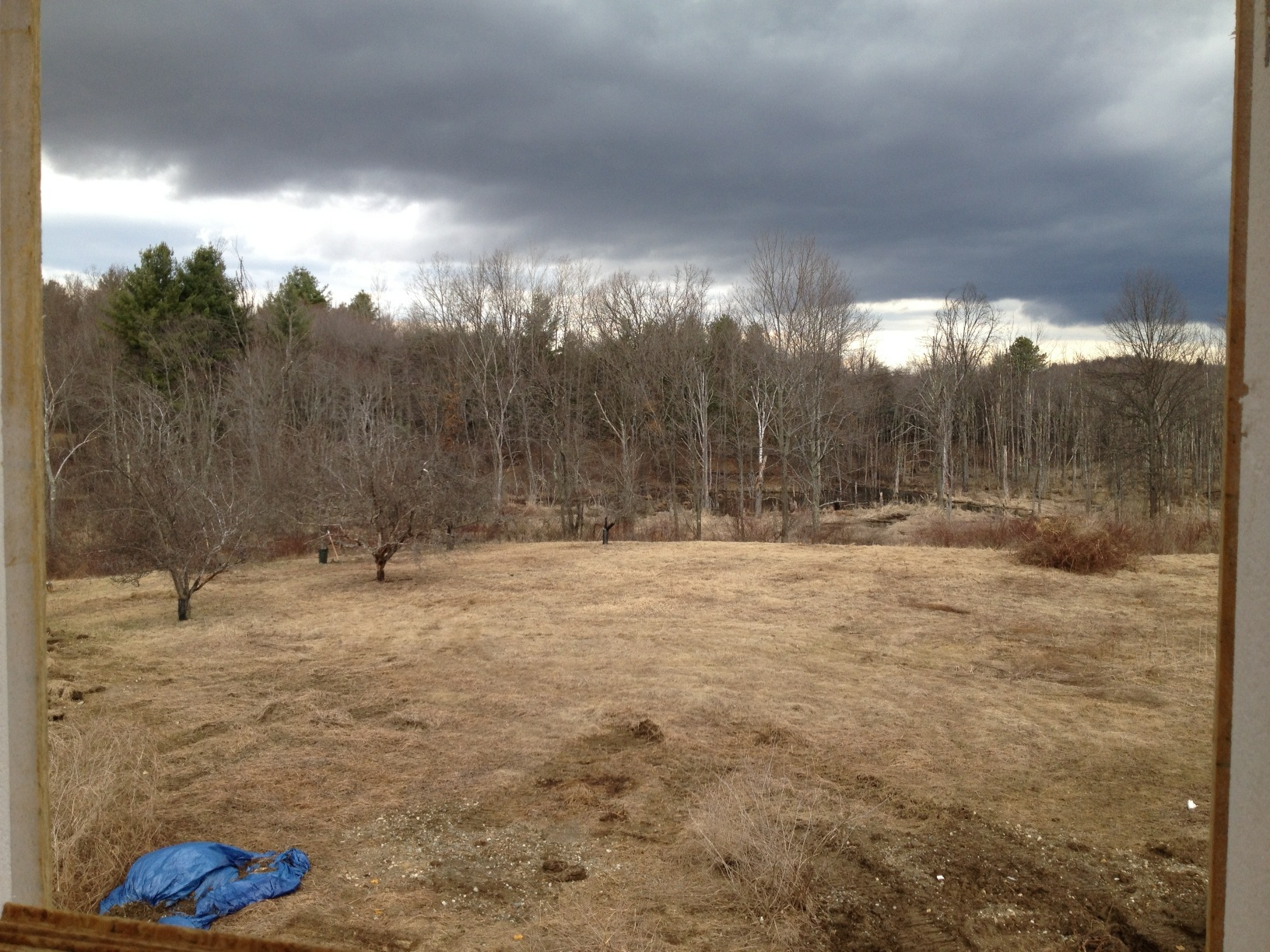
It’s interesting. Now that the walls are up, I’m more happy with the views out back. The walls do indeed obscure parts of the view that were wonderful, but now that you can’t see those parts, you don’t know they are missing. Instead, all you see is a subset of the view, but it looks charming regardless.

If you walk up to the rear bedroom window, you can get a pretty wide angle view, just not the whole wrap around view. Still, it would have been nice to have more windows on this side of the house, but I’m happy with how it turned out. Neighbor Jesse (an architect, coincidentally) says that sometimes it’s good to have to work for the view.

Details at the window frame and roof eave

ZIP sheathing at the window opening provides a moisture resistive barrier and air barrier all in one panel. The edge of the sheathing is taped around the corner of the rough opening.

At the roof eave, the ZIP sheathing is placed face down. The tape runs along the underside of the sheathing and is dangling out, eventually to be taped to more ZIP sheathing that will run under the roof truss. Lots of caulking went under the ZIP sheathing – between the SIP and the ZIP – presumably to allow the SIP to expand without lifting apart the critical ZIP barrier. More tape will go on the other corner of the ZIP where it meets the outer side of the SIP.

Roof trusses arrived

The roof trusses were manufactured off site and delivered on Tuesday. The lull came in handy for getting these up on the roof.

The rest of the week was spent working on the roof, even with two extra guys for some of the time. It seemed like a lot of work went into getting this part of the roof together.