Showing posts with label passive house. Show all posts

Monday, March 10, 2014

Week 9 - SIPs wall panels are here!

img-alternative-text

I got a text on Friday from my trusted neighbor-spy Jesse saying "SIPs just rolled in!" I was out of town, but on Sunday I got to check them out — notice the stacked, thick white panels sitting on the ground. Also, the tent for the concrete came down, so I got to check out the concrete in the full sunlight. It looks good — a huge relief!

SIPs are awesome!

image-2363

The image above shows a stack of five Structural Insulated Panels (SIPs), soon to be lifted by a crane and installed as the walls of the building. I mentioned SIPs in my overview post a while back, but let me tell you a little bit more about why these types of walls are such an important part of energy efficient design.

Why make walls in a factory?

img-alternative-text

Youve probably seen a traditionally framed wall at a construction site, a web of 2 x 4 or 2 x 6 lumber going in every direction. Long horizontal boards, called plates, are placed along the top and bottom of the wall, vertical boards, called studs, run the height of the wall and little horizontal pieces, called nogging, are placed in between the studs. You have to be careful to lay out everything so that the window and door openings are taken into account and adequately reinforced. Plywood goes on the outside once the lumber is in place.

img-alternative-text

On the other hand, our SIPs walls are fabricated in a factory in Vermont. The panels are huge, consisting of a single 8 inch thick slab of EPS foam sandwiched between two long pieces of oriented strand boards (OSB), and measuring 4 feet wide and two stories tall. The foam and OSB are held together with urethane glue.

Fabricating the panels in an indoor setting adds a number of advantages: automated machinery cuts and laminates the panels quickly and precisely without generating much waste; the shape and layout of the panels are digitally uploaded to the manufacturing equipment without the need to interpret drawings onsite; the quality of the panels can be tightly controlled and verified before shipping; and construction times are shorter because the panels can be made while the foundation is being constructed.

The end result is a monolithic panel that is airtight and super-insulated. The panels interlock, but you still have to seal the edges with tape. Although some builders use only the panels themselves as the walls, we will be adding 2 x 6 interior wall studs and blown-in fiberglass insulation to increase the R value of the walls and to provide space for electrical wiring.

youtube

In the video above, Matt OMalia describes the process of installing the SIPs at the GO Home.

Concrete floor looks great!

img-alternative-text

After a worrying about the concrete floor last week, I was excited to see how the surface of the concrete turned out. I think it looks great – it has a nice matt finish to it, some interesting texture and the color is pleasing. I guess it will add more of an industrial feel to the home rather than a fancy shiny granite look, which is cool — maybe even better than a polish.

This is better than polished concrete

There appear to be multiple definitions of "polished" concrete. The architect and builder told me that the actual grinding part of the polish – the part that gives it its mirror like shine – wasnt planned for, or included in the price. That step can be done later, if desired, but it would add a substantial amount to the cost of the floor. In the end, I think the builder went with the best of all possible options. Its the economical option because the expensive grinding process was omitted. Its the healthy option because we didnt use a chemical sealer. Plus, its the durable option because we used a densifier to harden the concrete.

img-alternative-text

The image above is a closeup of the concrete control joint, a cut in the concrete that promotes cracking underneath the joint, instead of along the surface. You can also get a better sense for the texture of the surface — its pretty smooth to the touch. Im not sure what part of the texture will wipe off when its cleaned, but Im feeling good about it, regardless.

Backfilled around the perimeter

img-alternative-text

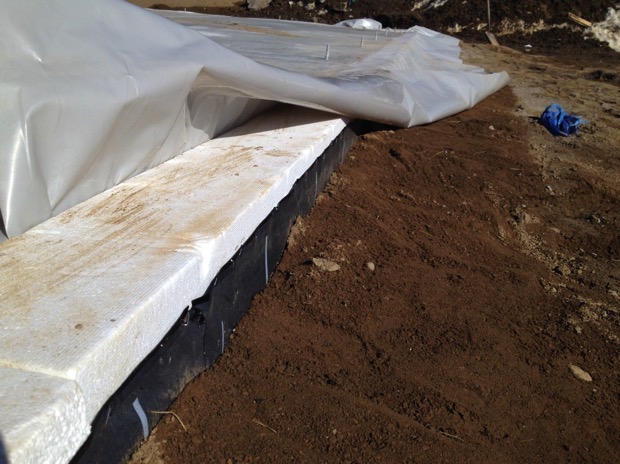
Heres an image of the EPS foam, having been lined with a black covering — the ice and water shield — and backfilled with dirt. Buried under the dirt is another EPS panel, a "wing" that serves to insulate the ground under the wing from frost. The gray plastic is the poly vapor barrier that forms a continuous seal underneath the concrete.

Wednesday, February 5, 2014

Why are passive houses so cute and boxy?

OK, now it’s snowing like crazy. Looks like there won’t be any progress on the construction for a while. In the meantime, I thought I would begin to explain some of the special traits of the Potwine Passive House in more detail. In the next post, I’ll show the floor plans, but first we should talk about why the home is shaped the way it is.

Passive houses tend to be cute and boxy

I love the look of passive houses. Pictured above are Little Compton (Zero Energy Design); Lancaster High Efficiency (Garland Mill Timberframes); Urban Green (Sala Architects); and R-House (ARO and Della Valle Bernheimer), clockwise starting from the upper left.

Less surface area saves energy

You might have noticed a common theme — these houses take the form of a box, more or less. Here’s why: it’s an attempt to achieve a low surface area to volume ratio. Imagine a square box versus a long rectangle, but make sure that both are sized such that they each enclose the same amount of volume, as shown in the drawing below:


In this example, both the cube and the rectangle have the same volume, but their surface area is different. It turns out that the cube will always have less surface area than the long rectangle, regardless of whatever volume we choose. Similarly, a box will have less surface area than a series of partially detached smaller boxes, which might remind you of most house designs.

The problem is that heat energy is lost through the surface area (the walls, roof and windows), so more surface area will allow the same volume of space to cool down faster. Passive houses often employ boxy designs because they yield better thermal performance.


I’m sure that many would find the typical boxy passive house to be extremely limiting, but that’s where the brilliance of architect Matt O’Malia’s GO Home is apparent (pictured above): he’s made a boxy and plain structure seem open, interesting and bigger than it really is.

Choosing the exterior form factor and the square footage


One of the project’s first steps was to choose among the preset house designs and floor plans available on GO Logic’s website, which offers single story 1000 sq ft plans up to double story 2500 sq ft plans. I initially came to the project thinking that I would want to live in a bonafide tiny house — a romantic dot on the landscape surrounded by expansive open space — but the thought of raising a family in a tiny house eventually scared me off. I gravitated toward a three bedroom design, partly due to the recommendation of my real estate agent, Mike Seward: three bedroom homes tend to be easier to sell. A second story appealed to me because I felt that views of the surrounding landscape and wildlife would be enhanced by the extra height, and more space around the home would be available for a vegetable garden.

After discussing my budget with Matt O’Malia, it was clear that the 1300 sq ft model was the most I could afford. Although I didn’t know it at the time, the actual usable square footage is even smaller: 1100 sq ft, about half the size of the average home in the US. At this point, most people would balk at the idea of a passive house: they could have a standard 2200 sq ft house for the same upfront cost! Don’t get me wrong: I’m not saying that a passive house is more expensive. The upfront costs are higher, but the monthly costs are lower (almost zero) — one of many ways in which greener products are unfairly financially disincentivised.

The next step was to figure out how to make the most of that 1100 sq ft.

Sunday, January 5, 2014

Hello neighbors postcards!

image-128

Some of my new neighbors might be curious about the activity on their street, so I made up this postcard that Ill drop in their mailboxes. I thought it would be nice to let them know whats going on, but really Im interested in getting started on my ambitious plan of world domination — by convincing everyone to live in ultra-efficient tiny houses!

Here are some of the most striking energy efficiency features of the Potwine Passive House, as listed in the postcard. Ill talk more in depth about these in future posts.

What is a passive house?

Originally popularized in the seventies by back-to-the-earth types, the passive house concept didn’t hit the mainstream until the early nineties when Professors Fiest (Lund University, Sweden) and Adamson (Institute for Housing and the Environment, Germany) took up the concept in earnest using a strictly scientific approach. The central thesis is that the greenhouse effect can be exploited in buildings to provide most of their heating needs. So much heat is available from the sun, in fact, that the original idea involved generating all of a building’s heat from the sun — hence the name passive: no active or mechanical processes would be required. A building would simply take care of its own temperature inherently, reminiscent of the clever designs of ancient buildings that functioned astonishingly well without a modern furnace or air conditioning. Today’s passive homes use many active mechanical systems like air conditioning and air ventilators, but the majority of heating comes passively, from the sun.

South facing windows are the critical source of heat

img-alternative-text

South facing windows can capture a tremendous amount of the suns energy in the winter while the sun is at a low angle in the sky. In the summer, when the sun is at a high angle in the sky, an overhang blocks light from hitting the windows to prevent excess heating. Windows facing west, east and north are kept to a minimum, if possible — they will lose heat while adding little solar heat gain. The challenge is to keep the south facing part of the building livable: too many windows will generate too much heat during the day and lose too much heat at night. We want just the right amount of south facing windows to generate enough heat, but no more.

R6 insulated triple pane windows make a huge difference

img-alternative-text

Windows are terrible insulators; they incur the greatest heat loss in most buildings. Increasing the insulating capability of the windows will result in enormous energy savings.

The actual amount of heat loss expected from a given type of window is quantified by a metric called the U-value, a measure of how much heat is lost per temperature difference between the inside and outside. A good double pane vinyl window will have a U-value of 0.37, given in the (stupid) US units of [Btu/hr SF ℉]. We’ve elected to go with German Kneer-Südfenster triple pane UPVC windows with an amazingly low U-value of 0.167, lower by more than half the U-value of a typical double pane window! This means that our triple pane windows will be retaining more than twice as much heat compared to double pane windows, and this will make a huge difference in energy savings.

The U-value is the inverse of the R-value, the common metric for insulation. Converting the U-value to the R-value of our windows gives an R-value of R6.

Concrete thermal mass foundation stores heat for the night

img-alternative-text

What happens at night when the sun goes down and it is cold outside? We want to be able to store the heat gained during the day and use it at night. That is, amazingly, exactly what the concrete slab foundation will do! The foundation of the home consists of a concrete slab sitting on top of a layer of insulating foam. The concrete serves as a huge reservoir for heat, helping to keep the temperature constant inside the home by absorbing heat during the day when the sun is out, and by releasing heat at night when the temperature inside cools down. The slab is insulated from the ground to prevent stored heat from escaping through the earth. The trick is to figure out how much concrete is needed to absorb a sufficient amount of energy during the day to keep the home warm at night. Too much concrete will never allow the home to get warm. Too little concrete will never be able to keep the home warm all night. The architect uses an energy model to decide how thick to make the concrete slab.

R50 insulated prefabricated wall panels

img-alternative-text

The walls are put together in a new and interesting way that helps lower cost, save time and reduce air leaks. Huge wall panels are prefabricated ahead of time in a factory setting, shipped to the building site and then hung on the frame. The installation process only takes a couple of days. The huge size of the panels minimizes the little cracks and seams that cause air leakage in traditional walls. The panels are called Structurally Insulated Panels (SIPs). The SIPs are 8" thick. A normal 2"x6" wall is added to the interior of the SIPs and filled with blown-in fiberglass, resulting in a super insulated wall assembly with an astronomical R-value of R50.

Heat recovery ventilation keeps the air fresh

A typical home leaks a lot of air to the outside. It’s equivalent to leaving the front door completely wide open! In many cases, the leaks are there by design: they bring in fresh air. But when a home is tightly sealed, things will get stinky pretty quickly unless you have a way of ventilating the place. The problem is that you can’t just open a window because you’ll lose heat (or cold) and defeat the whole purpose of tightly sealing the home. The solution is absolutely ingenious: a Heat Recovery Ventilator (HRV). The HRV brings fresh air into the home and simultaneously exhausts stale air to the outside, yet miraculously doesn’t allow heat to escape. I’ll explain how this works in a future post; it’s very clever.

Drain water heat recovery saves hot water

Hot water is a tough issue to solve. Heating up water requires a tremendous amount of energy. Many choose to employ natural gas water heaters, which are probably the most economical option (at least until the natural gas bubble bursts). Our goal is to go fossil fuel free, so we had to consider other options. In a future post, I’ll talk about why we ended up choosing on-demand tankless water heaters instead of solar thermal hot water or a heat pump water heater.

img-alternative-text

For the moment, however, let me tell you about one of the really cool aspects of our hot water system. Think about what happens when you take a shower. Hot water pours over your body and disappears down the drain. All that energy goes into heating the hot water, but most of the energy is immediately waisted down the drain. Enter the Drain Water Heat Recovery (DWHR) pipe: a drain pipe that recovers most of the heat in the water flowing down the drain and magically transfers it back to the inlet of the water heater. The operating principle is similar to that of the HRV.

LED lighting saves electricity

img-alternative-text

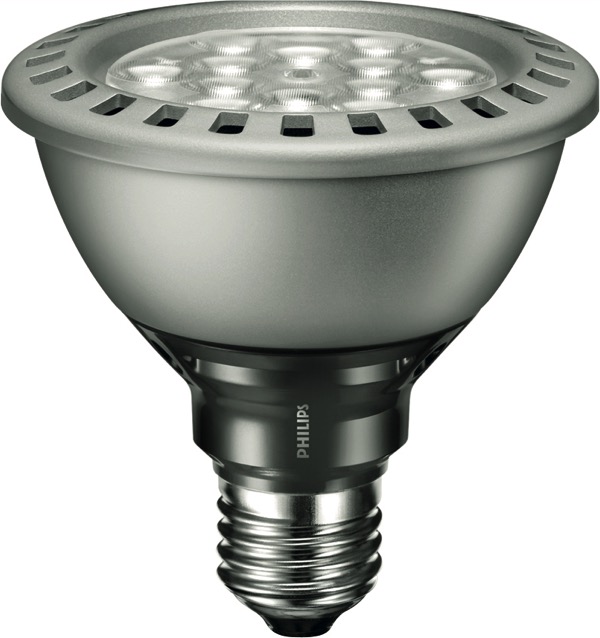
LED lighting represents a dramatic improvement in lighting technology, providing higher efficiency than incandescents, better color than fluorescents, dimmability and cost savings over the ridiculously long 40 year life of the bulb. Like most energy efficient options, the upfront costs are high, but you save money in the long run. We are outfitting the house with PAR30 (short neck) LED track lights. These bulbs are larger than your standard GU10 or MR16 halogen replacement track light bulbs, but they provide more light, are cheaper and are more efficient. A 12 Watt PAR30 LED replaces a 75 Watt halogen bulb, saving an amazing 84%!

Other cool features

Check back here to find out more about the other fascinating energy saving features of the Potwine Passive House, including:

  • An efficient box-shape building structure that retains heat extraordinarily well
  • A bunch of clever space saving architectural elements that make a small home appear more spacious
  • A 4kW solar photovoltaic (PV) array that will provide 100% of energy
  • Tankless on-demand water heaters from Stiebel Eltron, providing instantaneous hot water that never runs out, all in a tiny package at a low cost
  • An efficient Fujitsu heat pump, providing heating or cooling in one unit, at an efficiency more than two times that of a conventional heating system
  • An efficient heat pump dryer, more than twice as efficient as a conventional dryer
  • An efficient induction stovetop that boils water faster (while using less energy) than any other stovetop
  • An efficient steam oven that will cook a whole chicken in 20 min!
  • A recirculating range hood from Vent-a-hood
  • An eMonitor energy monitor that tracks the electricity usage of every circuit in the home

It’s not just a bunch of cool gizmos

Overall, I want to point out that the home is not just a bunch of really cool technological gizmos. It’s a fundamentally new approach to assembling a building. Beginning with the concept of using solar heat, most of the other features derive from this simple first step: a lot of insulation and a tight building envelope to hold in the heat, an HRV to bring in fresh air without losing heat, and a concrete slab to store the heat for later. The second important aspect is the elimination of fossil fuel combustion in favor of electricity. It just so happens that things that use electricity are way more efficient than things that burn fossil fuels. We benefit from this increased efficiency when we install the PV system, which will be much smaller than it would have been without all the super efficient components listed above. In a nutshell, it’s a smarter, more holistic approach. That’s how we expect to achieve a home that uses 8 times less energy than the typical Massachusetts home.

Tuesday, December 3, 2013

Huge energy savings possible with passive houses


A rarely known fact – and one I love to repeat – is that our wonderful modern society uses energy in terribly inefficient ways.  Few of us know how much energy is wasted when you flip on a light switch, but the answer is delightfully instructive, and shocking.  Powering a light bulb from the power grid is only 1% efficient.  A staggering 99% percent of the energy is lost (to heat, specifically), lost at each step along the way: first at the power plant, then in transmission to your home, and then within the light bulb itself as it operates.  Think about it this way: 99% of the pollution emitted from the power plant causes harm to someone (or something, or someplace) without anything to show for it.

If you can tackle poor efficiency, which happens to span all aspects of energy usage, you stand to gain tremendously; doing more with less and, in the process, causing less damage to your surroundings.  The chart below shows the predicted energy usage of the Potwine passive house, compared to that of the typical home in Massachusetts.  The savings are enormous – over an 8 fold decrease in energy usage overall, much of it simply from increasing efficiency and smarter design.  The lion's share comes from reducing the heating load of the house and adding passive solar gain, but switching to LED lights and more efficient appliances also makes an impact.

We'll see if these predictions actually hold true.  If they do, then we've realized a practical, economical, and sacrifice-free way of reducing household energy consumption in the US.