Showing posts with label beavers. Show all posts

Sunday, March 30, 2014

Week 12 - Second floor framing and a look at the beaver activity

Don, the carpenter, made tremendous progress again this week, especially considering the rainy and windy conditions. It’s such an exciting time. The house looks totally different every day. At this point, most of the second floor framing is in place.

I got to climb up on the second floor and have a look around. It was thrilling to finally be able to see the surrounding landscape from the second floor. I’ve been so curious to check out the window placement on the second floor, to see for myself what scenic landscapes are perfectly framed by the windows, and, sadly, what landscapes are obscured by the walls.

View from the second floor master bedroom

In the shot above, you are looking through the three master bedroom windows. The scene is framed wonderfully, I think. I love the straight driveway, lined with a row of trees, heading diagonally across the frame, drawing the eye toward the mountain. It’s more of an Amherst suburban feel, with roads, houses, fields and a mountain in the background. It’s a little weird that bedroom is exposed to the road, however. Maybe this room will have to be an office. I’m jealous of my neighbors who live on the south side of the road.

I can see Russia from my HOUSE!

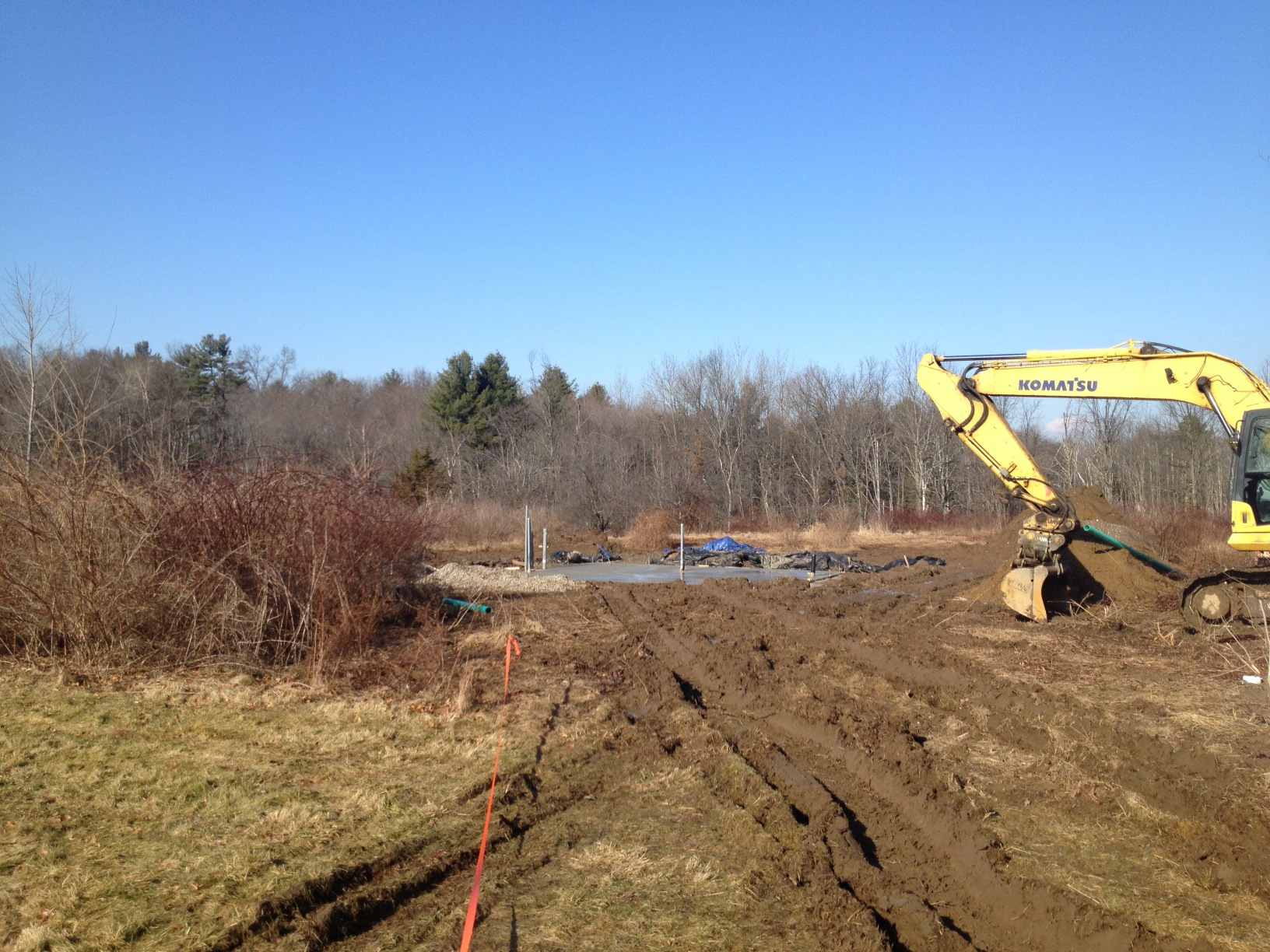
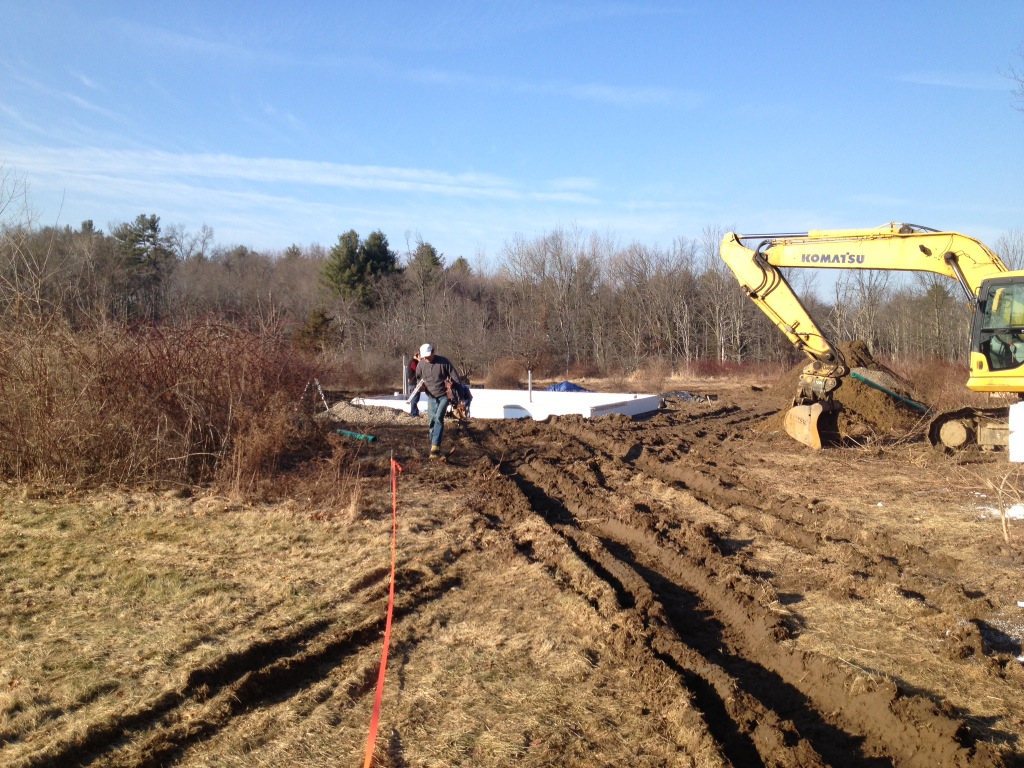
Looking north, out over the top of the stairs beyond the window in the stairwell, I was slack-jawed — the view of the natural landscape is absolutely spectacular and the wildlife viewing opportunities are going to be amazing. You can’t quite get a sense for the detail and the intricacy of the landscape without a better zoomed-in image, but it feels like you are a hundred feet up in the air and you can see forever. Beyond the excavator, one can see (not in this image) the northern most beaver dam. Off to the left are apple trees, wetland, a beaver lodge, beavers swimming in the water and a beaver dam.

I shouldn’t have built a passive house

If you read my last post, you know that I’ve struggled with the limitations imposed by Passivhaus on north windows. Climbing up onto the second floor, I couldn’t escape the feeling that I have made a huge mistake. I should have gone with 100% glass walls. The best views are going to be completely blocked once the SIPs are in place. This spot calls for a viewing tower, not a demonstration to the world of an affordable and charming zero energy house. I suddenly dreaded the day when the SIPs are put up and the expansive 360 degree views will be gone. If only Amherst was located in the southern hemisphere.

I’ve got a plan

While I was up there, I hatched a plan — a sort of compromise that will allow me to salvage my energy efficiency fanaticism while still being able to enjoy the vistas that I feel like I suddenly can’t live without: I’ll put up a second story deck. All I need is a window door, right at the top of the stairs, to the left. The deck will run along the left wall toward the back and wrap around the back side of the house. The super-insulated enclosure is preserved, and if you need to see two raptors fighting (this happened), you can go out on the deck. I can’t afford to modify the project right now, so it will have to be an add on at a later time. Hopefully, GO Logic will think it’s possible.

The magical wetlands in the winter

Now that the snow has melted, I tried to capture the wetlands in their lovely wintery state of dormancy. I wanted you to see up close what I’m talking about. It’s also neat to see the remarkable transformation the beavers have wrought over the past year and a half — an engineering marvel and an expansion of habitat for aquatic wildlife — but at the cost of what once was a wonderful portion of the town trail, a treasure to the community.

Definitely a beaver lodge

Check out this great peek at the beaver lodge! It’s the huge pile of sticks in the center of the shot. When I walked up to the lodge, the beaver popped right out and swam around for a bit. I can’t believe it took us so long to find the lodge — it’s in plain sight and you can literally walk right up to it. I bet the brush must have been pretty thick before it died down in the winter.

Beavers build their lodges with underwater openings as the only entry and exist points. You can see one of the entryways at the base of the tree. Another entrance is located on the other side of the lodge, upstream (the width of the lodge spans a narrow peninsula). The underwater entrance protects the beavers from intruders like bears and bobcats who apparently can’t figure out how to get in from underneath. Also, the underwater opening gives beavers access to the water when everything is frozen over and covered in snow.

Flooded wetland

Click on the panorama to see the large version. You are looking east toward the house (it’s up on the hill next to the excavator — you’ll have to zoom in). The beaver lodge is on the right, out of view. The old footbridge is on the left — again, zooming needed. The massive beaver dam is also on the left, although it is hard to distinguish from this angle. Notice how the brook snakes through the area, but don’t be fooled: the whole plain is flooded. You are seeing the top of the marsh grasses that have died and fallen over.

For comparison, the above image was taken a year and a half ago. Now, the water level comes right up to the bridge, at times nearly submerging it.

Another dam downstream

Beavers raise the water level in steps, by constructing multiple dams. Here’s another flooded area and dam, downstream from the previous image. Notice the huge pile of sticks and the dramatic decrease in the water level. The image is facing south — you can see Mount Norwottuck and the house in the distance. Neighbor Jesse tells me that this dam has been here for a long time. The dead trees are a sign of this, as well. The water level is still pretty high in front of the dam, so I think there is another active dam further downstream. The area is difficult to navigate so I haven’t been able to get in there and look around. I need a some sort of a miniature boat, like an Inuit kayak.

Sunday, March 2, 2014

Week 8 - Concrete poured, beaver lodge located

img-alternative-text

Suddenly, we have made major progress this week, despite the continued frigid temperatures! On Monday, the rebar was set into place and on Tuesday the concrete was poured. Everything seems to be going well, but not without some misunderstanding. Also, I think Ive finally located the beaver lodge.

Pouring the concrete

image-9

When I showed up, the first concrete truck had just finished pouring its portion of the concrete and the guys were spreading out the concrete and leveling it. The second truck was on it’s way, but I had to take off.

Power troweling the concrete all night

img-alternative-text

Later that night, I dropped in to find the concrete guy floating the concrete, using the power troweler on the right. After waiting for the concrete to cure until it was hard enough to walk on, he repeatedly ran the power troweler over the concrete until he was satisfied with the sheen. The process apparently took all night — it had to be done before the concrete hardened any further. Hopefully, the neighbors weren’t bothered by the sound of the generator.

img-alternative-text

Here’s the floor in the morning. It looks smoother, but what’s all that white stuff?

Is this polished concrete?

The concrete process seems to be deviating from what I expected, and I’m not exactly sure what is going on. We had decided on polished concrete floors — an agonizing decision because of a the $5/sq ft premium over traditional concrete, with a total cost of $15.6/sq ft. For comparison, $14/sq ft is the cost of a high-end wood floor. The concrete doubles as the foundation, so it’s not a fair comparison, but still — it’s not cheap.

Polished concrete has the advantage that it does not require chemical sealers or annual waxing, and apparently the look is better. As I understood it, the process for polished concrete follows these steps:

  1. Once the concrete hardens, it is ground down to a smooth finish, exposing the aggregates in the concrete.
  2. A densifier is applied to the concrete to harden it, providing a hard surface that does not need maintenance. The densifier is a non-toxic mixture of silicic acid, potassium salt and water that reacts with the concrete to produce calcium silicate hydrate, a super-strong material.
  3. The hardened concrete is ground down to a progressively finer finish until the desired polish is achieved.

It looks like the concrete guy is actually going down a much different route, which might end up fine, but I’m worried about getting a floor that looks like a basement rather than something that suits a living room. One aspect that concerns me is the troweling process, described above. Apparently this process buries the aggregates under the surface of the concrete, giving a more homogenous appearance that is typical of a concrete floor. But the texture that the aggregates provide seems to be partly what makes polished concrete look so good. I’m crossing my fingers that it will turn out OK. I’m also wondering where the $5/sq ft premium went.

img-alternative-text

On Friday, after a couple of days of curing, the densifier was applied. I’m hoping that those scuff marks are not permanently engrained in the concrete. I guess there’s no turning back now.

img-alternative-text

Here’s one of the two massive propane burners, running 24/7 for a week now to keep the concrete warm.

Did I find the beaver lodge?

img-alternative-text

To relieve my worry about the concrete floor, I decided to go check on the beavers. I think I found their lodge, but I’m bothered by the fact that it is so close to the trail — it seems like I would have seen it earlier. Notice the pile of sticks covered in snow, right at the center of the photo. It could be a random pile of sticks, but the location makes me think it is a lodge. Look at how the lodge is situated right at the crux of the stream’s oxbow — this is exactly the same positioning as an abandoned beaver lodge further down stream. My guess is that theyve installed two entryways, one downstream and one upstream.

img-alternative-text

The beaver dam is still holding up well. This most extensive dam in the area. Starting from the lower right side of the image, the dam runs diagonally and then continues to zig zig into the distance, making its way to the hillside that you can see in the background — a massive work of engineering.

Saturday, January 18, 2014

Week 2 - The foundation and a beaver update

The flowable fill

I got a text on Wednesday from my neighbor Jesse saying “concrete!” and I dropped the grant proposal I was editing and raced over to the lot. When I showed up, though, I realized that it wasn’t concrete — even though it looks like concrete and the truck probably looked like a concrete truck — it was the flowable fill.

What’s flowable fill? Here’s a closeup. It’s a thin layer of cement, sand and water mixture that provides at flat, smooth and void-free surface. It’s not as strong as concrete, but doesn’t need to be: it’s simply a more convenient option than trying to smooth out the base layer of structural fill (the compacted sand/gravel mixture). The various pipes that you see sticking up are the electrical lines and water lines (in the center), the sewage drain (on the right) and the conduit for phone, electricals, cable and some other mysterious stuff that I don’t know about (on the left).

Here’s the cross section of the whole foundation, called a frost-protected shallow foundation (FPSF). More info is available in an article written by Alan Gibson, co-owner of GOLogic. Alan describes the cost savings of a slab foundation, the site preparation requirements, the foam insulation requirements and the technique for pouring the concrete.

Beaver update, bad news

It was such a nice day that I took a walk down to the brook to check out the amazing tulip trees (Liriodendron) that Vivienne had told me about. The beaver dam is still holding up, even through all the rain, snow and cold.

To my horror, I discovered yet another disaster wrought by my ungrateful squatters, the beavers. Two magnificent willow trees by the road have been chewed all the way around the base their trunks. Vivienne says this will likely kill the trees, as the layer of wood directly underneath the bark is the layer through which the tree’s nutrients are transported. So sad. Thankfully, someone has saved the other trees nearby by installing chicken wire, but I suppose they figured that the willows are a lost cause.

The EPS foam is in place

On friday, Bruce (the carpenter) and Jim (his helper/painter) installed the Expanded Polystyrene (EPS) foam.

They fit the foam pieces together like a jigsaw puzzle on top of the flowable fill and reported that it was relatively easy to set everything in place. The 8" thick foam pieces are apparently heavier than they look. The raised side wall will insulate the side of the concrete slab while also creating a bowl in which to pour the concrete. You can see that half of air-vapor barrier has been laid down already. Next week, hopefully, we’ll get to pour the concrete.

Saturday, November 30, 2013

After a year of work, almost set to begin

In retrospect, it was not a wise decision to build this house.  It's been over a year now of endless catastrophe -- an emotional up and down of "wow this is the best thing ever" to "how did I get myself into this anxiety-producing, money-losing, relationship-killing mess."  I consoled myself by walking down to the bridge to take in the beautiful landscape, until the beavers moved in and flooded the place.  Then it was the apple orchard, a delightful spot in the spring in full bloom, until I arrived to find three trees chopped down.  Securing the loan and signing the construction contract was a difficult process; long and stressful, with many painful financial decisions -- everything about the entire house had to be fully specified.  Now, in spite of all this, a permit is likely to be issued soon, and once that happens the project is set to begin, ushering in a smooth, effortless and faster-than-expected building phase; I'm sure of it.

Bridge crossing the brook that runs through the wetland area, a wonderful spot now flooded by beaver dams.

One of the magnificent apple trees, in full bloom before the beavers got to it.