Sunday, May 11, 2014

Week 18 - Driveway complete, a little bit about the heat pump

The driveway is done, and little bits of progress have been made here and there on the roof trim, the building wrap, the upstairs ceiling. The piping for the heat pump was installed, and I’ll tell you a little bit about the amazing science behind the heat pump below.

Driveway is done, almost

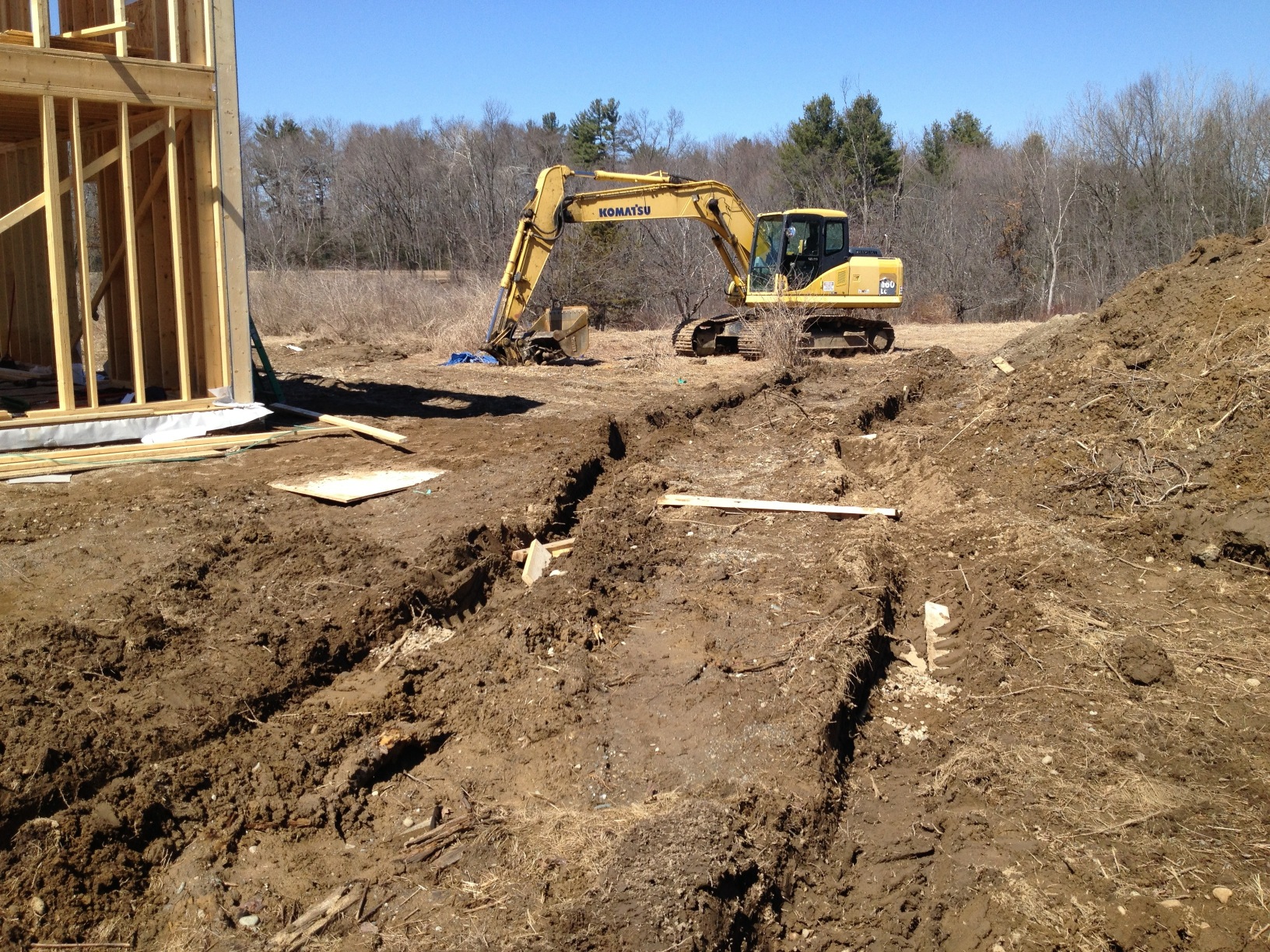
The most expensive part of the entire project – the essentially unnecessary driveway – is almost done. Normally, you want to complete the driveway first, before embarking on construction, but our project got off to a late start and the winter prevented us from doing driveway work until now.

Above, a sheet of fabric is put down to separate the bottom layer of dirt from the top layer of “gravel” – that’s what the guys call it even though it looks like dirt to me. I suppose keeping the two layers separate helps stabilize the driveway.

The tiniest steamroller in the world is compacting the gravel — it’s adorable. After construction is complete, a final layer of “TRG” (I don’t know what it stands for) will be placed on top of the dirt. The TRG consists of small stones and sand that compacts well and can be plowed in the winter.

Now that the dirt is compacted around the home, delivery trucks don’t have to worry about getting stuck in the mud. My only concern is that I want to have a vegetable garden in front of the house and I’m worried that these vehicles compacting the soil will make the ground less amenable to cultivation. The driveway guys didn’t seem to think it was an issue.

Work on the roof trim

I’m not sure how he got up there, but somehow Don got started on the roof trim – see the white boards along the edge of the roof – without scaffolding or a ladder. When I asked him how he did it, he said: “I’m a monkey.” Next week, the metal seam roof will go up and Don is eager to borrow the scaffolding that the roofers will put up.

The R100 vaulted ceiling

You might remember that the ceiling upstairs will serve as the air and moisture barrier, with an astonishing 26 inches of blown-in cellulose as insulation on top of the ceiling (in the roof truss) giving an out-of-this-world R value of R100! The ZIP sheathing (in green) is placed face down on the underside of the roof truss. On the lower right hand side of the image, you can just barely see how the taped seal runs under the roof eave and attaches to the underside of the ceiling ZIP.

The building wrap

A delicate process, reminiscent of wrapping a Christmas present, is required to seal the moisture barrier around the window openings. First, the air barrier is taped at the edge between the window frame sheathing and the SIP OSB, shown above.
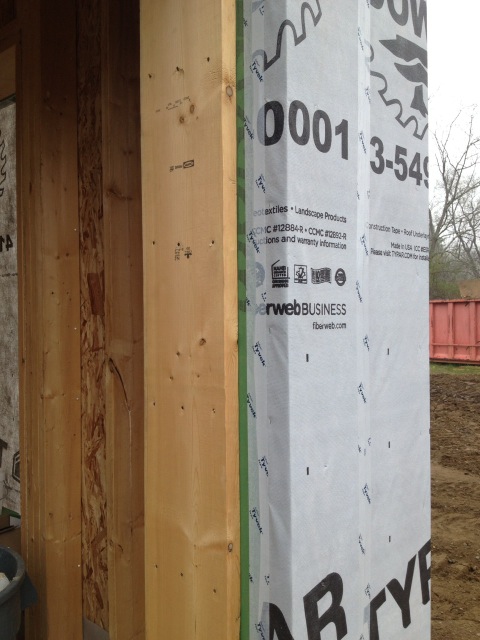
Second, the building wrap is taped to the window frame sheathing.

Getting the edges right is always the tricky part. An extra piece of tape goes right at the corner, running horizontally along the inside crease of the window frame.

The heat pump

I’ll talk more about the heat pump later when it actually gets installed, but for now, here’s a quick overview.

The heat pump provides both heating and air conditioning. We’ve chosen a mini-split, dual-zone, ductless model, meaning that there is an outdoor unit (a condenser) and two wall mounted indoor units (the evaporator cassettes) connected by two refrigerant lines (a gas line and a liquid line). This is different from central air conditioning or forced air heating where a central unit in the basement blows air through ducts to each room.

How does a heat pump work?

It’s a complicated process — a miracle of science — and you need to know a certain amount of thermodynamics to really understand it, but here’s how a heat pump (as well as your air conditioner and your refrigerator) works, in a nut shell.

The outdoor condenser, which houses a big noisy fan and a noisy compressor, serves to turn the refrigerant from a liquid to a gas (when in heating mode). The refrigerant is piped inside to each wall mounted indoor unit which simply blows air over the refrigerant — turning the refrigerant back to a liquid — and in the process extracts hot air. The cycle runs in reverse in air conditioning mode, turning the refrigerant from a gas to a liquid outside and extracting cool air when turning the refrigerant back to a gas. The process can move heat around at a seemingly impossible efficiency of almost 400%, way better than a normal furnace which might be 70% efficient.

The refrigerant lines

Here’s where the outdoor unit will go once the siding is finished. Those bunches of tubing puncturing the wall are the refrigerant lines.

Inside, the tubing snakes through the walls to the evaporator unit. A water line allows condensed water to drain away. Notice how much simpler it is to install these lines than it would be to install all of the duct work for a central heating or air conditioning unit.

Why don’t we need heat in every room?

The home is so well insulated and so tightly sealed that the temperature will be essentially even throughout the entire house. You just need to add a bit of hot air at one location and the heat will eventually propagate everywhere. We have one cassette upstairs for cooling in the summer and one unit downstairs for heating in the winter. The thermostat will be set to a given temperature window and a minimal amount of energy will be required to keep the temperature constant. A great feature of these heat pumps is that they can run at extremely low settings, quietly trickling in the tiniest amount of heat without having to noisily cycle on and off like a traditional system.

Monday, May 5, 2014

Week 17 - More driveway work

Continued work on the driveway prevented much of anything else from happening this week. I realized that I’m having some regrets about the whole driveway operation. But, one thing turning out perfectly is the placement of the window locations.

I should have gone off-grid

The driveway work is a huge operation that has been taking more than twice as long as expected. The exposed electrical, phone and cable conduit are laid down in the trench above. They will be covered up next week. Sewer and water lines have already been put down and buried. The total area that was dug up covered the entire width of the original driveway, a gravel driveway that was perfectly usable as is. At $50k, it’s the single most expensive part of the construction.

What if I didn’t need all those hook-ups to the street? The sewer line could have been replaced by a septic tank. Maybe the water line could have been replaced by a well. Phone and cable are basically obsolete: satellite can accomplish the same thing. The remaining challenge is to provide off-grid electricity, which would have required solar panels and lots of batteries.

Off-grid might have been cheaper

Given the cost of the driveway, off-grid electricity might not be as far-fetched as you might think. Right now, the cost of batteries is not subsidized and is therefore not competitive economically. However, battery costs are falling rapidly and their performance has been improving steadily. Remember when your laptop lasted only two hours on a charge? Now, thin and lightweight laptops will last all day on a single charge. According to one group, off-grid solar photovoltaics plus battery storage will be cheaper than grid electricity in five years in the Northeast.

Assuming a well and a septic tank would have cost $25k, the remaining $25k could have gone toward solar panels and battery backup. A 2kW solar array will only cost about $8k, leaving $17k for batteries. Batteries for three days of storage (11kWh x 3 = 33 kWh) might cost about $7k ($200/kWh x 33 kWh = $7k), leaving an extra $10k in savings! Wow. It is possible that I would have needed to double the solar array size in order to account for peak demand, but still. I had no idea it would be so close.

Beautiful pictures of window openings

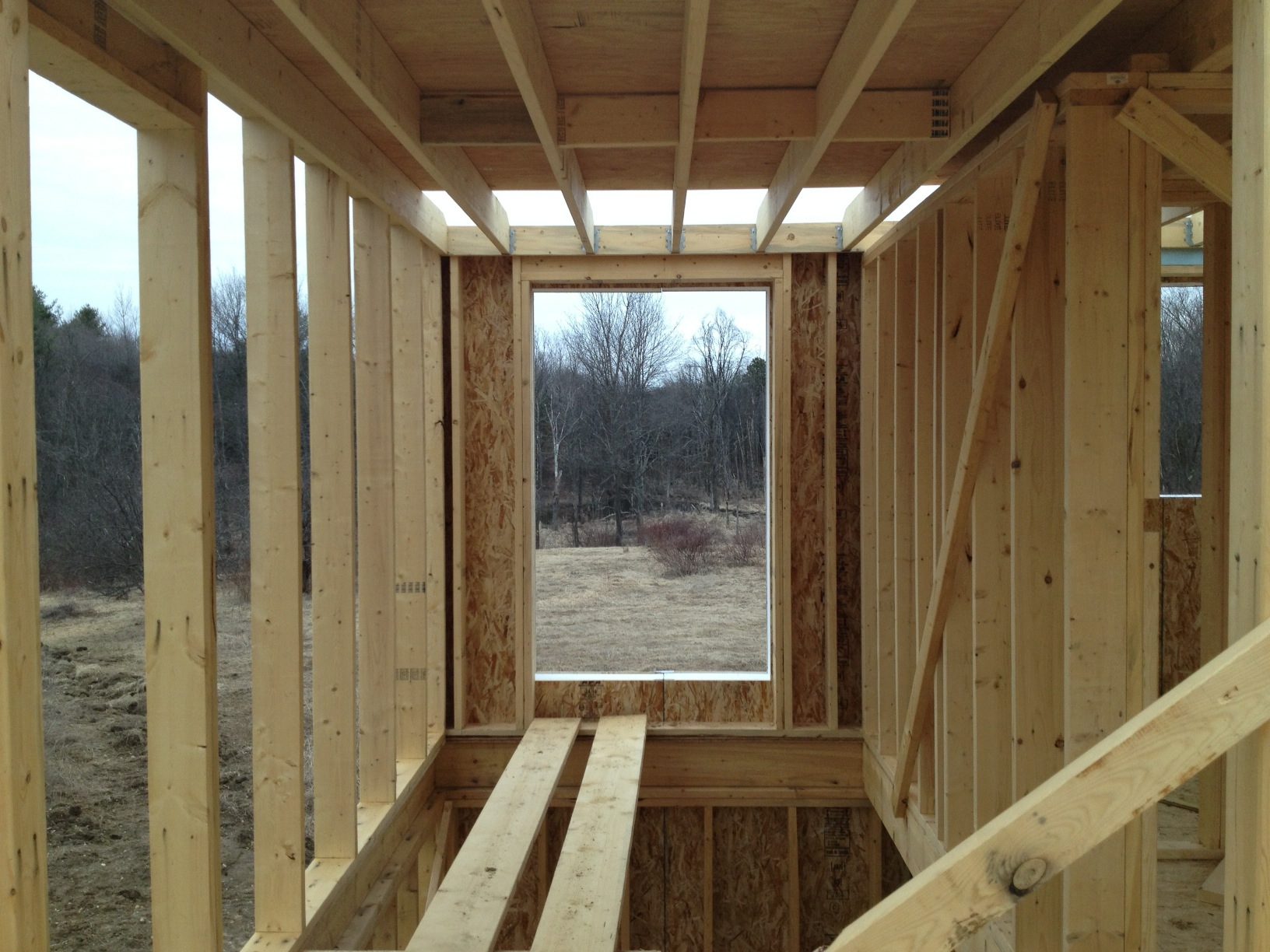
A great thing happened when I was showing my neighbor, Nancy, the house for the first time. As she walked up the steps, she exclaimed: “Oh, look at the mountain!” I was beaming inside. Nancy had no idea how much thought and energy went into to crafting the top of the stairway. I can’t believe it actually worked as planned.

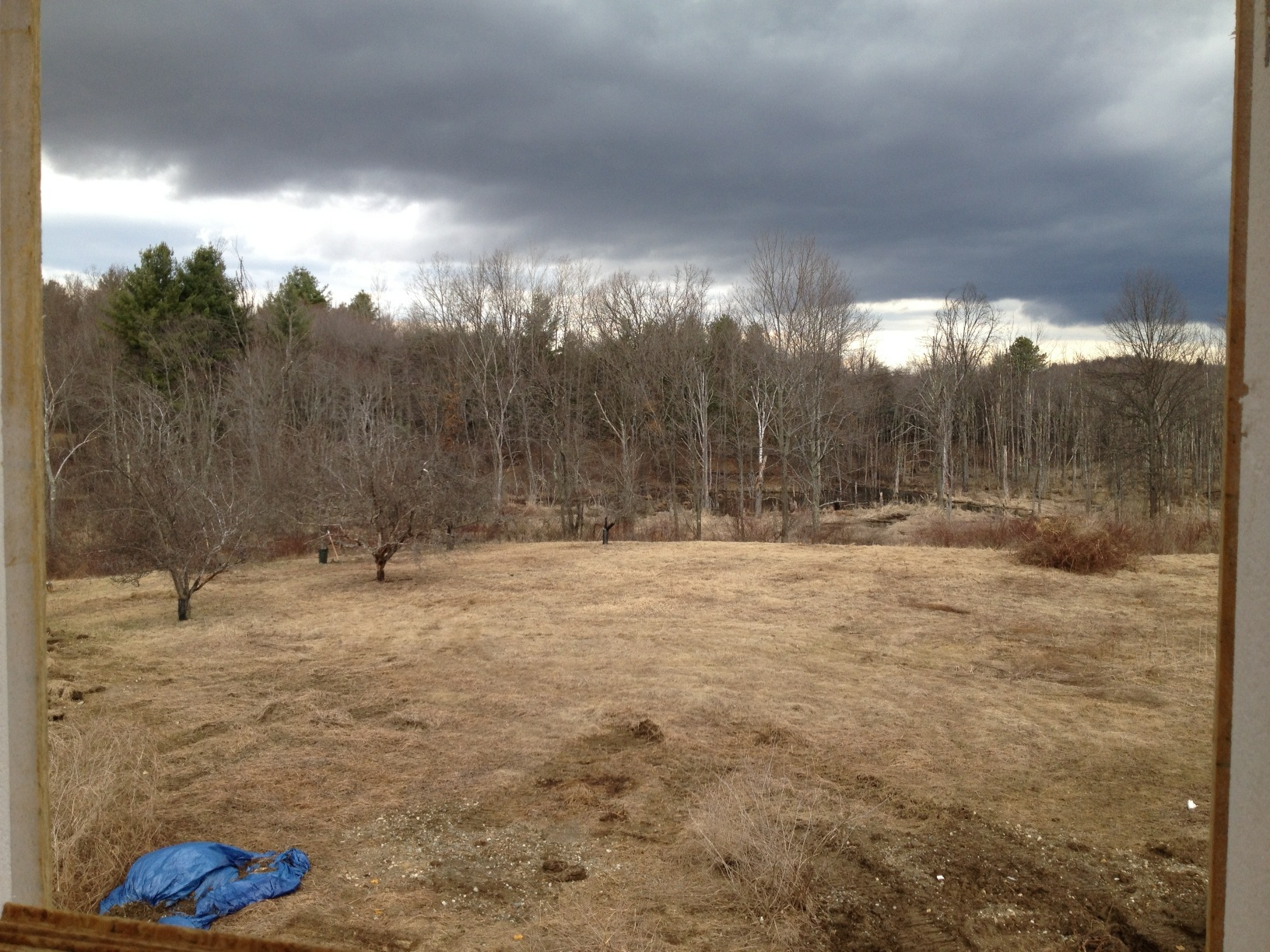
The view out the back toward the apple trees is stunning in the afternoon. You can see the damage left by the crew who put in the drainage pipe. I still have to figure out who to flatten it out.

The front door (entrance through the back side of the house) will be a full glass door, allowing you to glimpse out the back from the kitchen and dining area.

Monday, April 28, 2014

Week 16 - Starting on the driveway

This week, work began on excavating the driveway to connect the utilities to the street. Everything was supposed to be done by the end of the week, but it looks like we’re only about half way there. Work on the house slowed down substantially, although some window framing got done and some of the building wrap went up.

On Monday, Don put up the building wrap around the first floor. The building wrap is meant to allow moisture to exit from inside the walls, but not let moisture into the walls. I have no idea how that is possible, but apparently it works.

Believe it or not, the building wrap that you see is one single piece! It defies logic how Don managed to string up the wrap by himself, holding it up while taping it to the wall while making sure that it is flush and wrinkle free. Not to mention, it was getting windy that day.

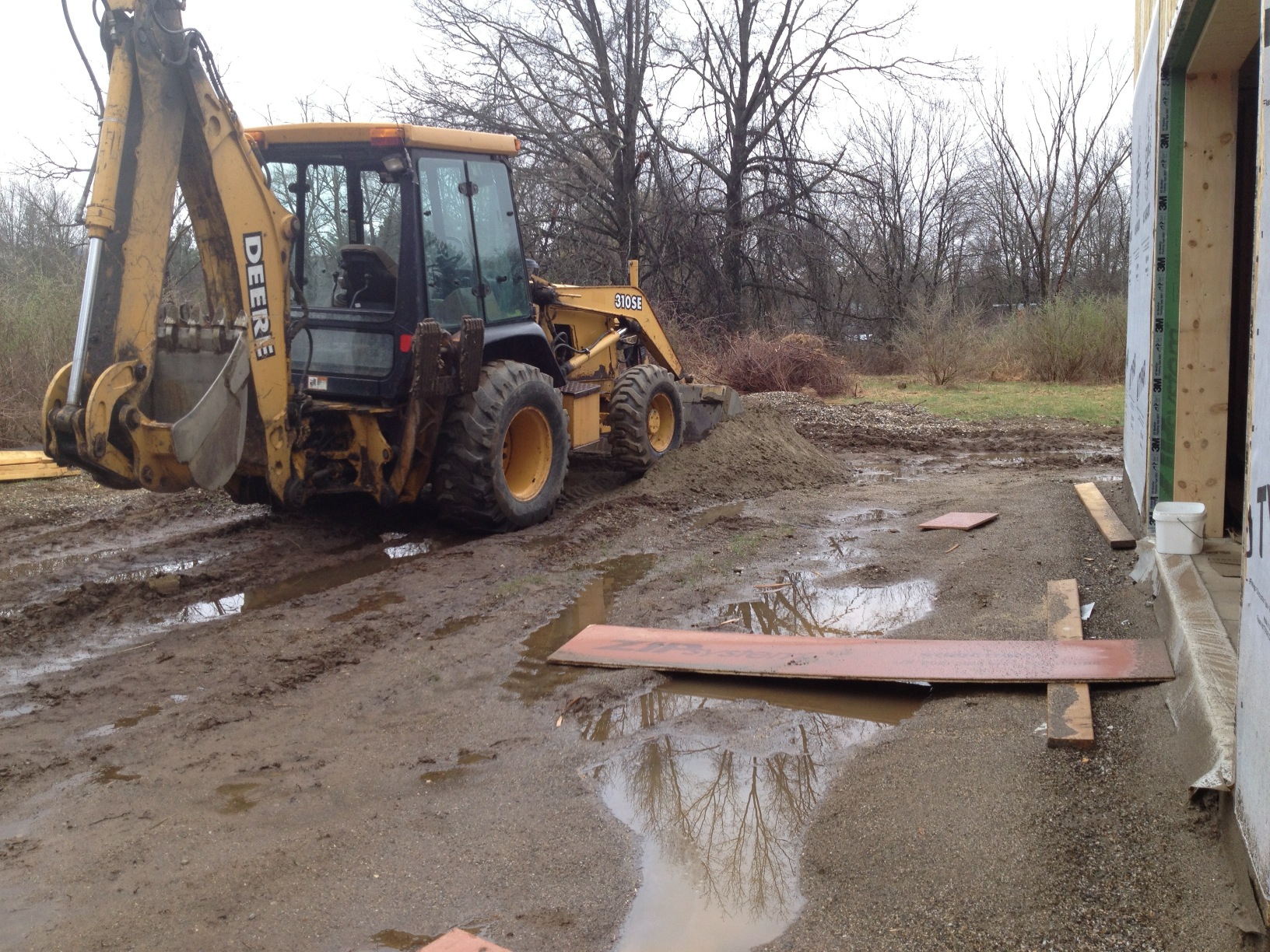
Excavation got started on Wednesday. Tractors and diggers arrived, as did piles of gravel and engineered dirt. I missed most of the action, but the neighbors said there was lots of activity.

Buried under the dirt are water lines, sewer lines, electricity, phone and cable, each spaced apart a certain distance specified by the code. The end result is a wide area that needs to be dug up even though the actual pipes aren’t that big.

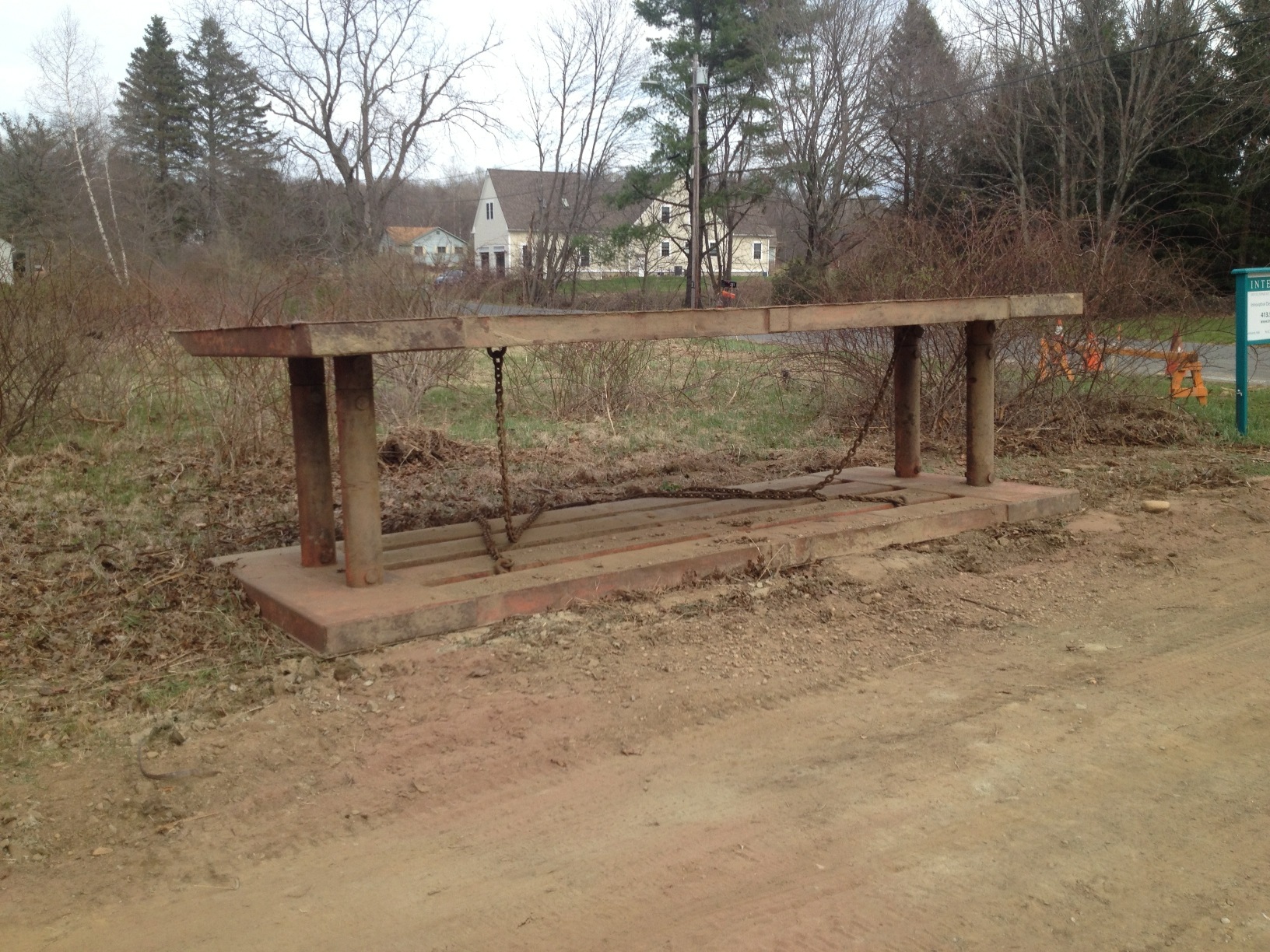
The good news is that the sewer at the street turned out to be 15 feet deep, allowing us to drain into the sewer using gravity rather than a pump. The bad news is that it must have been quite a challenge to get down there. I’m guessing these big steel braces help keep the dirt from collapsing while the pipes are connected underground.

Here’s the location of my future vegetable and native plant garden, under which lie electrical conduit. I’m hoping the soil doesn’t get too disturbed or compacted, but I guess that’s far fetched.

Wednesday, April 23, 2014

Week 15 - Roof is up, working on window framing

The week involved finishing the roof sheathing, working on the window frames and building a temporary staircase. Things are starting to get detailed, and are taking more time. Below, I’ll show how the windows are framed since the process appears to be non-standard (and important).

Roof almost done before the snow

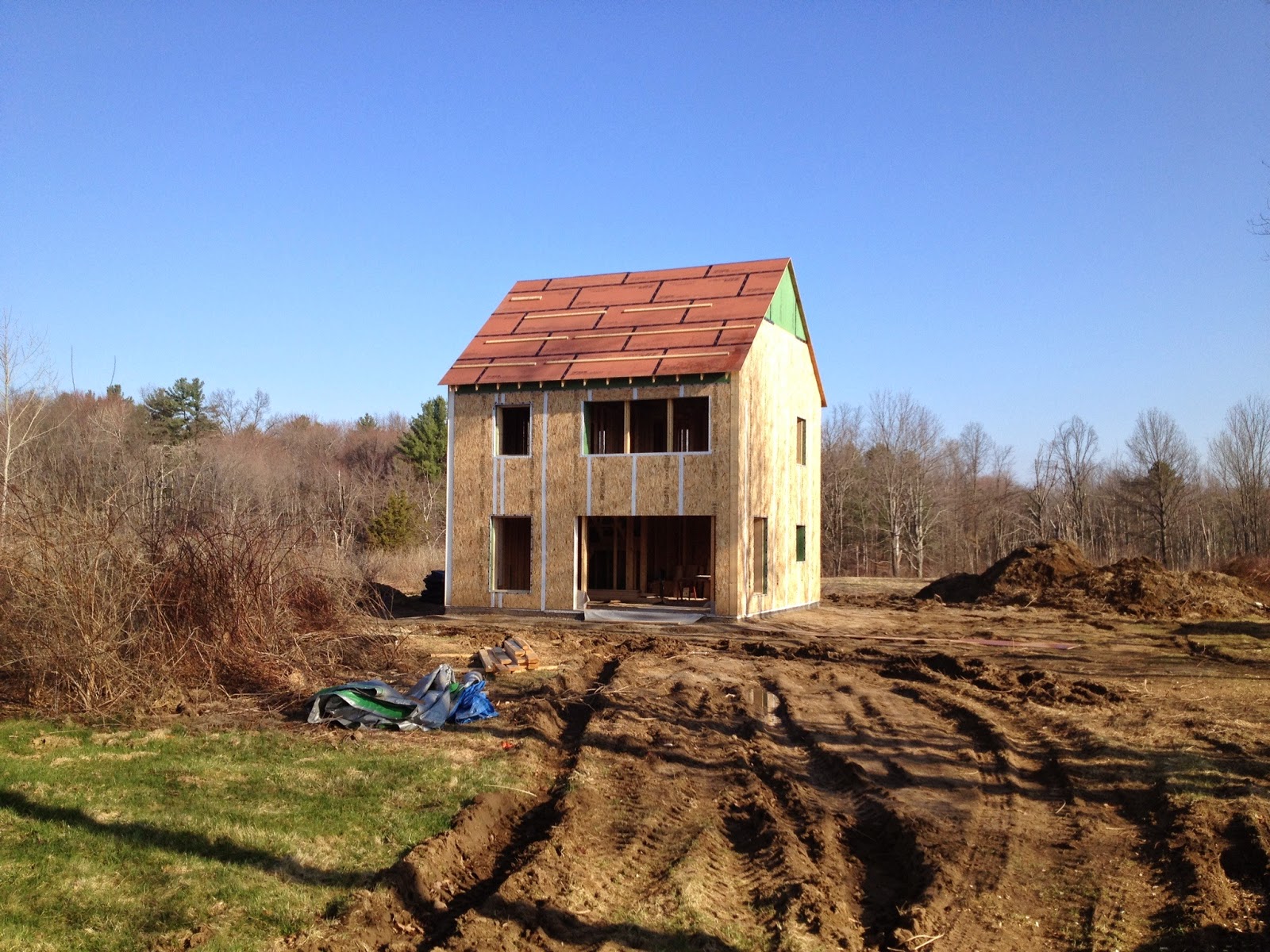
Don almost had the roof complete before the wind picked up and nearly blew him off (according to how he tells it). The next day, the rain and snow ended up getting everywhere. Above, a little bit of snow is still left on the roof after the storm. I love this shot of the back of the house from the apple orchard. As architect Todd said: “the house sits nicely on the land.”

A look at the scissor roof trusses

Here’s a cool shot of the scissor trusses. ZIP panels will be attached to the underside, forming the air barrier as well as the gabled ceiling of the two front rooms. Almost 2 feet of blown-in cellulose insulation will go on top of the ZIP panels, outside the airtight envelope. There is some reduction in the insulating ability of the cellulose due to the fact that cold air will be able to move through the insulation, but the advantage is that moisture will not get trapped.

The roof truss at the eave sits on the ZIP air barrier. The ZIP will continue along the scissor truss. Notice how the floor joists are angled to accommodate the ZIP and drywall.

It takes time to frame these windows

Normally, the window framing would be complete at this point (except the sill is missing in the image above). With our construction, the window frame spans two walls: the SIP wall and the stud wall, so there’s quite a bit more to do. The two walls must be bridged in a way that is airtight and moisture repellent. Don and a helper spent much of the week finishing the extra steps to frame the windows, and reported that the process was somewhat elaborate and time consuming.

First, if you look closely at the SIP part of the frame, you’ll see a gap between exterior OSB panel and the foam insulation. That gap is meant to allow 2 x 2 wood pieces to be wedged there, to provide somewhere to nail the rest of the framing to the SIP.

Next, the green ZIP sheathing is nailed to the frame, bridging the two walls. Caulking is applied under the ZIP to prevent water and air from migrating horizontally.

2 x 10 boards are nailed to the ZIP to provide a solid wood frame, to which the window can be attached. Again, caulking is applied under the boards.

The entire window frame has the appearance of being over-engineered — it’s three boards thick in some places. I wonder if this bomb-proof structure is by design — to reduce load stresses and sheer stress from the windows — or if it’s just a function of having to deal with the SIP wall and stud wall discontinuity. As you might imagine, measuring all these boards, caulking and nailing takes a substantial amount of time.

But we’re not finished. Outside (1st floor window pictured here), the SIP is affixed to the interior window frame with gigantically long screws, and then tape is applied where the ZIP meets the SIP. As far as I can tell, this location — the outside of the SIP — is the primary air barrier. The window will sit right on the edge of the innermost 2 x 10 boards.

Sunday, April 13, 2014

Week 14 - Starting to look like a house

The walls are in place and the roof trusses are up. Don and crew are now working on the roof ZIP sheathing. It’s starting the come together and look like a house! The weather has been amazing, and that might be a big reason why so much got done this week.

Using the lull to raise the SIP walls

The ground dried up enough so that Don could maneuver the lull through the mud, allowing him to raise the SIPs on the east and west sides. These panels are considerable bigger than those on the north and south sides. It would have been difficult to lift them by hand, so we really lucked out.

The movie shows the lull lifting the SIP, with a rope used to stabilize the SIP. Notice how the SIP starts to slip off the fork, and then the guys on the roof were able to pull it back into place, but not before having to walk out on the headers like acrobats. They are fearless. Keep in mind that there’s no floor under them – they are balancing on the header beams, and on one side there’s a two story drop!

Once the lull got the SIP most of the way up, the guys on the roof were able to pull it upright against the house.

To help lift the panel onto the foundation ledge by hand, a little plastic handle came in handy.

Sliding these large panels over was difficult, so the lull was used to push them in place. For some reason, the panels on this side came out bowed and it was tough to get them to interlock. Using the lull to push on the panel, the guys banged furiously on the seam, gradually jostling the two panels together.

Update on the views from the windows out back

It’s interesting. Now that the walls are up, I’m more happy with the views out back. The walls do indeed obscure parts of the view that were wonderful, but now that you can’t see those parts, you don’t know they are missing. Instead, all you see is a subset of the view, but it looks charming regardless.

If you walk up to the rear bedroom window, you can get a pretty wide angle view, just not the whole wrap around view. Still, it would have been nice to have more windows on this side of the house, but I’m happy with how it turned out. Neighbor Jesse (an architect, coincidentally) says that sometimes it’s good to have to work for the view.

Details at the window frame and roof eave

ZIP sheathing at the window opening provides a moisture resistive barrier and air barrier all in one panel. The edge of the sheathing is taped around the corner of the rough opening.

At the roof eave, the ZIP sheathing is placed face down. The tape runs along the underside of the sheathing and is dangling out, eventually to be taped to more ZIP sheathing that will run under the roof truss. Lots of caulking went under the ZIP sheathing – between the SIP and the ZIP – presumably to allow the SIP to expand without lifting apart the critical ZIP barrier. More tape will go on the other corner of the ZIP where it meets the outer side of the SIP.

Roof trusses arrived

The roof trusses were manufactured off site and delivered on Tuesday. The lull came in handy for getting these up on the roof.

The rest of the week was spent working on the roof, even with two extra guys for some of the time. It seemed like a lot of work went into getting this part of the roof together.

Saturday, April 5, 2014

Week 13 - Getting the SIP walls up!

It was an exciting week. Don finished the second floor framing and spent Thursday and Friday putting up the SIPs along the north and south walls, with the help of two younger guys. They were an awesome team to watch, constantly bantering, moving here and there, helping each other out, and communicating about tactics, problems and next steps. It’s great to see an experienced team — a fine tuned machine — working like that. They are, however, pretty cavalier about running up and down the ladders — the most jiggly and unstable ladders I’ve ever seen — which was scary to watch, but entertaining.

Forklift instead of a crane, didn’t work out

Instead of a crane, Integrity decided to use a large forklift to lift the SIPs. A crane is more expensive than a forklift and it seemed like it would do the job just as well. Turns out that we didn’t even need the forklift. It got stuck in the mud around the perimeter of the home, and wast therefore totally useless. It’s not clear from the image above, but those tracks are at least two feet deep.

Raising the SIPs

Instead, we carried over the SIPs by hand and raised them by walking it up from one end, as the video above shows. It’s pretty heavy, but doable.

The whole SIP installation process

First, narrow strips of OSB are measured and cut, inserted into the grove at the SIP’s edge, and nailed into place. These inserts help lock the SIPs together.

The plastic vapor barrier is wrapped from under the concrete, over the EPS foam, back over a piece of plywood directly on top of the foam, and then up along the frame. A double strip of caulking is applied to the plastic at the ledge where the SIP will sit.

Once the SIP is standing vertically, it must be lifted up onto the ledge, which is awkward, but the guys were able to do it — they seem to have fingers of glue. Then the SIP is slid over against its neighbor. It is surprisingly easy to slide the SIP along the ledge, apparently due to the smoothness of the plastic and an ample amount of caulking. Banging along bottom of the SIP gets the bottom end flush with the adjacent panel (to within an eight to a quarter of an inch), where it is fixed with a nail before the top is wedged into place, bringing the whole panel flush with its neighbor.

The image above shows Don nailing the panel to the insert.

A 2 x 8 board is laid in the grove at the top of the SIP and nailed into place.

Gigantic screws fasten the SIP to the frame.

By the end of Thursday, almost the whole north wall was complete.

Because of the extra spacing between each panel, about 1/2“ to 3/4” had to be cut off of the end of the panel to make it flush with the frame.

Finally getting to see how the window openings look

I’ve been looking forward to seeing how the top of the stairway would turn out for about a year now. Looking out at the window over the stairs settles it: let’s remove the shelving at the top of the stairs — the view would be interrupted too severely. The question remains: how will we make up for the lost storage space?

Looking in the other direction, the study window feels a bit small, but the mountain is nicely framed.

Adding the third window in the middle really makes this view from the master bedroom work. I’m so glad we decided to go with it.