
Welcome to the Potwine Passive House, the first certified Passivhaus in Western Massachusetts. Follow along the checklist to make sure you see all of the features of the home.
Outside

Entryway

Kitchen

Living/dining room

Upstairs


Is it possible to live without burning fossil fuels? We are attempting to build a zero energy house, fully powered by the sun and following Passivhaus design guidelines, to answer that question.
Welcome to the Potwine Passive House, the first certified Passivhaus in Western Massachusetts. Follow along the checklist to make sure you see all of the features of the home.

Take a look at some of the amazing projects by the phenomenal students in Phys/Envst 104 this semester. Phys/Envst 104 (Renewable Energy) is a general education science course I teach at Mount Holyoke College.
The air is stiflingly hot. You realize you can hardly breathe. Your skin feels like it is catching fire. Your alarm wakes you up.
It is often said that music is an escape from the reality people live in. Listeners can drift off into whatever Nirvana or fantasy they would like. Allowing the melodies and lyrics to ebb into their thoughts and
produce feelings they were not otherwise feeling. But what if music started to reflect people’s reality.
The lyrics and melody becomes a part of the listener so if the lyrics were to inspire change, there would be more initiative towards improving the state of our environment.
The 6:30 alarm goes off, and you roll out of bed. In that groggy, barely awake moment, what is the first thing you do? You flip on the lightswitch. This is a simple action that occurs every morning and throughout the day, but hardly ever does the average person give a second thought to what energy source is supplying power to that lightbulb or where that power is coming from.
Our project strives to highlight the differences in overall efficiencies of coal power plants and renewable energy sources, including the long term monetary benefits of switching to renewable sources.
With current technology, electric cars rely on lithium batteries. Because lithium batteries are the foundation of the future, it is essential to understand the process of lithium mining and its possible impacts. The purpose of this project is to provide information about the mining process itself, but also to raise concerns and explore political, environmental and economic impacts so that further improvements can be made if necessary.
With the climate crisis looming over our heads, it’s easy to quickly point blame at the industrial giants and overlook our own contributions. How much do our seemingly simple day to day actions, down to what we put on our plates, have an impact on our climate? The power to create and ensure a sustainable future comes from a rather unsuspecting place: your plate. The agricultural and food industries are big players in the topic of climate crisis, and what we decide to consume can either drastically help or hurt that.
Responses:


Pigeons scuttling across city sidewalks in the winter wind. Bees and butterflies slowly reviving spring flowers. Crickets singing in the grass on warm summer nights. Squirrels hoarding acorns in the fall. What if one day none of that happened? You’d realize something was wrong, but how late would you be? We, as humans, focus almost entirely on ourselves: how much longer will we have the resources we need? How many more people can the world support? How can we produce, transport, and store enough food? How can we make sure we survive, regardless of the cost?
Per capita meat consumption has more than doubled in the past half-century. Linked with global population growth, the overall demand for meat has increased five-fold. The meat industry has put a heavy demand on resources, limiting the availability of water, land, feed, fertilizer, and fuel. American fast food chains have thrived on the novelty of a classic burger. Long lines at the drive- thru highlight consumerism at its finest. However, does each consumer ever think of the environmental footprint that goes into creating that one burger patty?
The US experiences the 4th greatest wealth inequality compared to 141 other countries. 578,424 people were reported to live without housing in 2014, and 46.7 million are living in poverty. That’s more that 14% of our population. We have all been told that solar power is going to save us. Solar power can produce upwards of 147kWh/day/person and in an ideal world; solar power would be as commonly used as gas and coal. We decided to break down the financials of installing and using solar power, in order to provide more insight as to whether it's a viable alternative as we combat climate change.
Download a pdf of the flyer
Download a pdf of the workshop flyer
In our curriculum we want to incorporate the knowledge on the four renewable resources and how important it is to replace fossil fuel use with solar or wind energy. We feel it is also important to cover how much we use and waste daily; how efficient our energy usage daily is, and how harmful human impacts on the environment are. We will use a hands-on approach that gets students moving and interacting with these topics, because we feel they will identify more with the issue. We ultimately want to empower the youth to take action because they are instrumental in advocating for change.
While complicated scientific jargon may make understanding environmental issues seem like an impossible challenge, the truth is that our everyday actions have real, important consequences for the environment, and the mission of this blog is to make climate change concrete. To show the ways in which your actions matter. We will challenge and we will educate. We will put the power of climate justice where it belongs: in your hands.

Our current world relies heavily on conventional fossil fuels: coal, natural gas, and oil. We're expected to run out of these energy resources by the end of this century at our current rate of consumption. What will we do for energy next? Before we turn to renewable energies, we might look into more unconventional fossil fuels, one of these being methane hydrates.


Most of us give little thought to the act of flipping on a light switch, much less the enormous infrastructure that must go into the vast process of bringing electricity to nearly every corner of our beautiful modern world. And what about the remarkable scientific advancements that brought us from candle light to electrification over the past 100 years? How did that happen? It’s a small dot in the history of humankind, but a time of unparalleled change that revolutionized how we live, think, communicate, treat disease, and interact with the world. Electromagnetism is probably the single-most important scientific advancement in the history of humankind, and we’ll try to understand a bit about it here, at least enough to understand why electricity and magnetism are central to our ability to end our addiction to fossil fuels.
Walking through London in the 1830’s, you would have had to use a torch to see where you were going — in the middle of the day. The pollution was so bad that darkness descended on industrial cities, at certain times of the year, as it often does today in some parts of China. But at the time, people were thrilled about a new exciting discovery — the electric motor. Trains, cars and even boats would soon be powered by clean electricity rather than coal. It never happened, of course, because people soon realized that batteries didn’t last forever and were tremendously difficult to keep replacing. Despite this spectacular flop, I’m here to tell you that — this time — it’s going to be different!
Rub your hands and you can feel the texture of your skin, the soft muscle tissue wrapped over a hard skeleton. The nuclei of the atoms in your hand contain most of the mass — the heavy part — but they are spaced a surprisingly long distance apart. Consider this: if the nucleus was as big as you are, the next nucleus would be a mile away! There’s a tremendous gap of wide open space between every nucleus in your hand, occupied by essentially nothing, except for the occasional electron. The standard picture of atoms packed tightly together, with electrons spinning around the nucleus, is totally wrong. The real picture is one of mostly empty space. Why then can’t one object pass right through the other? Why doesn’t light pass right through the desk in front of you?

The answer is: the electrons. Electrons float around in the empty space, sometimes tied to a nucleus, sometimes allowed to roam free. It is the repulsive force between the electrons in your hand, and the electrons in whatever you touch, that gives the sensation of “touch.” You are physically feeling electric repulsion — the collision between electrons that don’t want to mix. You are physically seeing the collisions between light and the electrons in the table. These electric forces are strong, they dominate how we interact with the world, and they can generate spectacular effects like the Aurora and lightning. You might wonder why electrons don’t want to mix. Unfortunately, I can’t answer that one. No scientist can — we just don’t know why.
Electrons move extremely slowly. Getting through a wire is tough work. There’s a lot of bumping into the lattice of the nuclei. Electrons move at about one meter per hour — unbelievably slow. How is it, then, that you can Skype across the world in real time? How is it that you can flip the light switch and immediately the lights flick on?

Think of a long high speed train packed with people. It’s so tight that no one can move. Now try to push someone in at one end of the back car. The only way to let that person in is if someone else gets off at the other end of the train. The only movement that must occur is for everyone to shift down a bit. The actual movement of the people is slow, yet the response of everyone shifting down a bit can propagate along the train at a much higher speed. Pushing electrons down a wire is how we move energy, almost instantaneously, through wires. Plug your cell phone into the wall, and you can’t start charging until someone starts shoving electrons into the wires at a power plant miles away. It’s amazing.
You marveled as a little kid at the amazing forces of attraction and repulsion between two magnets, depending on their orientation. It’s a magical force, invisible yet so strong. For all of the 19th century, while the technology of electricity and magnetism was developing, scientists had no idea what was actually going on. It turns out that magnetism is, in part, also a property of electrons. Unlike electric repulsion, however, magnet repulsion has an orientation. The direction in which the electron is pointing determines if the magnetic force is attractive or repulsive. Amazingly, all the electrons in magnetic materials like iron are naturally aligned to point in the same direction. You can think of it as a conspiracy. What is their ultimately goal? No one knows, but I think they are trying to tell us to solve the climate crisis by using the powers of electromagnetism.
There’s another way to obtain a magnet other than pointing all of the electrons in the same direction. It turns out that running electrons through a wire can also produce a magnet. As the electrons move through the wire, from their perspective, the nuclei in the wire actually contract a little bit, leaving an electric imbalance between the electrons and the nuclei. This contraction is due to the very not-obvious fact that everything that moves actually get squished a tiny amount. You might have heard of Einstein. He figured this out.

The strange thing is that this electric imbalance depends on the direction in which the electrons are moving, similar to how the magnetic force depends on the direction the electrons are pointing. In fact, the direction of the force is the same for these two cases, and everything else about the two forces happens to be the same, so we go ahead and call them both magnetic forces. It’s wild, but you can create a magnet by moving electrons through a wire.
I realize that things are starting to get pretty weird, but it gets even worse. Not only can you create a magnet by moving electrons through a wire, but you can also create electricity by moving a magnet nearby a wire.

Take a wire, and take a magnet. Move the magnet. The electrons in the wire will get pushed through the wire by the magnetic force. Essentially, the electrons are responding to the motion of the magnet by turning themselves into a magnet. You can sit there all day and wiggle the magnet back and forth and you’ll get current wiggling back and forth. And that is basically how electricity is generated.
We can also do this in the opposite direction. Take a wire. Run electrons through it. The wire will produce a magnetic force. Place a magnet nearby. The wire-magnet will feel an attraction or repulsion from the magnetic force of the magnet, just like a normal magnet would.

What’s amazingly cool is that you can wrap the wire around a shaft and, together with the nearby magnet and electricity, cause the shaft to turn! And that is basically how an electric motor works.


So much for my plan to update the blog every week. Ive been super busy, but at the same time the project slowed down to a crawl, so Ive bunched up the past month and a half into a single post. The builder had other jobs. We were waiting for this and that. Sadly, carpenter Don came down with lyme disease, but hes doing better already after a round of antibiotics. After a month and a half, we got the roof on (1 day), the blower door test done (2 hours), the rough plumbing and electricals (3 days), the insulation (3 days), the drywall mostly up (1 week) and the exterior window framing mostly done (lots of time).
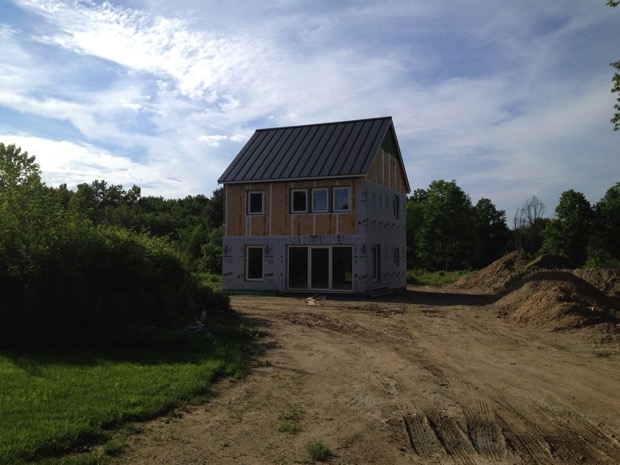
At first, the standing seam roof looked amazing, with a deep rich grey color and thin sleek seams widely placed apart. I was glad we went with the more expensive 24 gauge steal which is thicker, formed in the field, and doesnt have the more industrial looking ribbing.

But then I noticed that when the sun is high up in the sky, which happens to be a common occurrence, the roof material looks like a tin can about to crumple – kind of a cheap look for an expensive roof. Apparently, this is a common occurrence with standing seam roofs, a trade off for the extra durability and sleek look. By and large, the roof looks great from almost every angle, just not from the road during midday.

The blower door test is like a baseball pitchers earned run average (ERA), its the ultimate measure of the builders prowess. Everyone was anxious about how the test would turn out.
A critical part of the passive house concept is to seal the envelope of the building in order to prevent hot air from seeping out, and to avoid drafts of cold air from seeping in, which tends to be unpleasant in the winter. To verify the degree to which the house has been sealed up, we need to measure the flow of air passing through all of the little unsealed cracks in the envelope.

To do this, we replace the front door with a fan and use it to blow air out of the house, and then measure how much air passes through the fan. The flow of air passing through the fan must be equal to the flow of air through all the little breaks in the envelope; there is no other place for the air to go. Presumably (Im guessing here), the fan is calibrated such that the air flow can be determined from the fan speed, at a given pressure between the inside and the outside. The measured flow is not necessarily the real air leakage, however. The standard pressure used is 50 Pascals, which is substantially greater than you would normally get from wind or your ventilation system, but it serves to make sure everyone is testing under the same conditions.

We hooked everything up and started measuring the flow, then ran around the house feeling for drafts to plug up. We found a couple of spots in the attic around the HRV where the exhaust and inlet ducts penetrate the air barrier. It seems that the HRV got positioned too close to the wall so it was difficult to tape around the duct adequately. Also, the angle at which the ducts cross the sheathing is not ideal. Its always tough dealing with subcontractors: they dont have much interest in making sure the air barrier will be easy to seal.
After plugging everything up, we got a final flow measurement, in units of cubic feet per minute (cfm). The certification guy (Mark Newey, of CET) then calculated the number of "air changes" per hour, meaning the fraction of air that would leak out of the house during an hour, arriving at 0.23 ach at 50 Pascals, an unbelievably awesome number! The passivhaus target is 0.6 ach and almost nobody gets down near 0.2 ach. We high-fived each other and went home. Only later — when I relayed the information to the architect — did we realize that we were using the wrong number for the volume of the home. In reality, the result came to 0.34 ach, still an excellent number and a huge testament to the amazing craftsmanship of Don the carpenter and the rest of the Integrity team.

At the last minute, GO Logic was running through their heating demand calculations and realized that the home wasn’t going to meet the 15 kWh/m2 per year goal set by Passivhaus. We decided to increase the thickness of the inner stud wall from 4" to 6" and to use blown-in fiberglass instead of blown-in cellulose, for its better R value. Cellulose is often recycled, but there is some concern about the fact that it is treated with chemical fire retardants, so I was glad to not have to worry about that. The fiberglass is made of recycled glass and does not need to be treated with fire retardants.

The first step is to put up a mesh consisting of a teflon paper type material.

The fiberglass is blown in through holes in the mesh until the stud cavity is completely filled and the fiberglass is compacted, creating a interesting artsy wall with a quilted look.
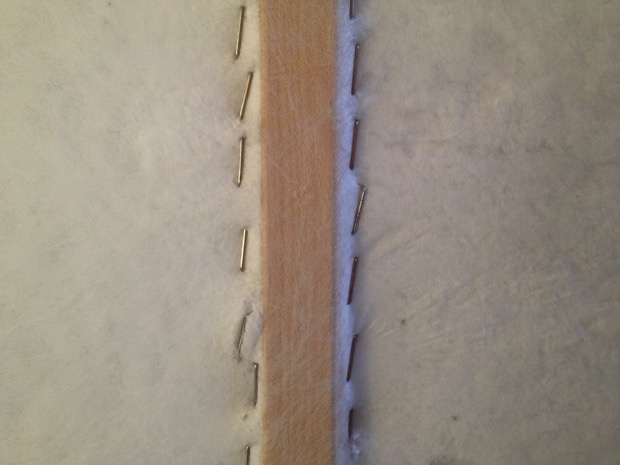
To keep the mesh from bulging outward, it is stapled at the studs, which makes for a cool stitch pattern. Too bad the walls are going to get covered with drywall.

No offense to the drywall crew, but drywall strikes me as completely useless. The amount of material used is enormous. It’s bulky and heavy and takes forever to install. It uses up space and, after it was installed, it made the rooms feel smaller. Why not just tack up a thin panelling material?

It’s a good thing we enlarged the window to the stairway, and also good that it’s an operable window, otherwise it would have been impossible to get the massive drywall panels upstairs. Passing them through the window was still a major exercise. There must have been four or five loads, each as massive as the one you can see in the image above.

The drywall really makes the rooms feel closed-in and small, but apparently once the rooms get painted they open up again. I’m keeping my fingers crossed.

Finishing the drywall took one guy over a week, being careful with the corners and sanding down everything nicely.

The upstairs hallway is starting to feel like a super nice spot in the home. It feels luxuriously large for a small home — almost too large — but I think we made the right decision to keep it big. For a while I played with tightening up the hallway to give more room for the bedrooms. In the end, the bedrooms indeed came out tiny, but that’s fine. For someone like me who struggles with insomnia, you want to keep your bedroom for sleeping, a dedicated space without distractions. The hallway, on the other hand, gets a lot more usage and impacts the feel of the home in a greater way: it’s your first impression as you walk up the stairs and it’s a common space that gets a lot of traffic.

Here’s a look at how sharp the drywall edges came out, which really helps give the windows a crisp modern look.

Most of the week was spent finishing the window frames, a long and arduous process that seems to have taken 99% of the time spent building the house. I’ll have to write a dedicated post in the future describing the window framing. Each window required so much measuring and cutting and fitting things together — it’s like building a delicate piece of furniture, but the piece is hanging one story up in the sky and you need a ladder to access it.

The aluminum flashing was formed by Don in the field and careful cut and wedged into place.

Here’s a shot of the spacers that will keep the siding offset from the walls. The little gap between the siding and the wall allows air to flow from under the siding up into the space just below the roof, rising at it warms up and serving to prevent the buildup of moisture that can lead to rotting.
Be sure to check out the photostream for more detailed images (with captions) of whats been happening. At the moment, however, the photostream is down, but hopefully Apple with have it back up soon.

I was out of town for weeks 20 and 21, so I missed out on the whole window installation process, which was a major bummer. Kathy stopped by after week 20 and sent me some pictures of the windows, which helped prevent me from being eaten alive with curiosity.
Kneer-Suedfenster is a German window company that’s been around since 1932. Their windows are custom sized, passive house certified, triple pane, high quality and — surprisingly — cheaper than Marvin double pane windows.
Since Integrity hadn’t installed Kneer-Suedfenster windows in the past, GO Logic sent down one of their carpenters from Maine to give a demo installation and to inspect the windows after their long trip from Germany. The guys reported that the installation was easy. Most of the windows were in place after three days of work.
Oh no! Check out how much the actual window area has shrunk! Back when the SIPs were installed, the window openings were already squeezing me in. Now I feel like I’m on an airplane looking through a port hole. I guess it’s the price we pay for energy efficiency — windows lose a lot of heat, and even the south facing windows upstairs have to be kept small to avoid over-heating on sunny winter days. The small size of the windows upstairs is probably the biggest — or maybe the only — serious sacrifice that the Passivhaus standard has brought, but it’s still hard to swallow.
The master bedroom widows, however, work well at this size. The three widows let in a good amount of light and allow a nice view of the hillside, but still give you a bit of privacy.
Once you walk up to these windows, you notice how exquisite they are. The handles make you feel like you’re getting into a Mercedes. The feel is solid. The look is simple and elegant. The clicking and latching sound of the locking mechanism is reminiscent of a car door unlocking. There’s even a whooshing sound as the seal is broken as the window opens.
The thickness and heftiness of the window is ridiculous. It feels more like you are opening the door to a vault at the bank than a window. The triple paned glass must be almost two inches thick!
There are three levels of rubber seals to ensure that the window is air-tight, in addition to a bomb-proof locking mechanism that locks at multiple points all around the perimeter.
Most windows in the US either slide up or sideways, or have that little ridiculous crank handle at the bottom that is impossible to use. Tilt and turn windows, popular in Europe, open inward like a door (shown above). It’s easy, convenient and satisfying — you get a full wide open window that brings in a ton of fresh air. You can pop your whole body out the windows for a good look around. You can clean the outside of the glass and install the bug screen from the inside.
For just a little bit of fresh air, turning the handle upward allows you to open the window from the top down — the tilt position. This is great for when you don’t want to deal with a wide open window or it’s raining outside.
At the last minute, GO Logic panicked about meeting the passivhaus heating goal of 15 kWh/m2 per year. They decided to widen the set of three large downstairs windows which let in a large chunk of the solar heat. It made sense to increase their size, but the dining room area now feels much more wide open than I originally imagined. The inside feels too exposed to the street and the window layout feels somehow out of balance. From the outside, the vertical symmetry between the upstairs windows and the downstairs windows is awkwardly upset.
I might just need to calibrate myself to the new look, but I can’t help but feel that this scenario illustrates something broken with the passivhaus design process. The last minute redesign probably resulted in a tiny reduction of the actual heat load — just enough to bring us under the 15 kWh/m2 target — but it forced a number of errors and difficult compromises to an otherwise well planned project. I don’t have an easy prescription for avoiding this situation in the future, but there must be a better way.
There are three important terms.
U-Value is the thermal conductivity of the window, often given in units of [Btu/hr SF ℉]. Lower U-Value is better for keeping heat in the home. Take the inverse of the U-Value to get the R-Value, which is typically used to describe the thermal resistance of walls. Air has a much lower thermal conductivity than glass, so trapping a pocket of air between two glass panes dramatically reduces the thermal conductivity of the window. A U-Value of 0.5 is horrible. A U-Value of 0.1 is fantastic.
Visible Transmittance (VT) is the percent of visible light that passes through the window. A higher VT is generally better, unless you want to avoid direct sunlight or glare. Lower VT windows will look tinted.
Solar Heat Gain Coefficient (SHGC) is similar to VT, but for the whole solar spectrum. One amazing fact about the solar spectrum is that heat itself is radiated in an identical way to light — as photons. Radiant heat is light, we just can’t see it with our eyes. In fact, most of the energy in the solar spectrum is in the form of invisible heat photons. SHGC describes the fraction of the total solar spectrum (heat plus visible light, plus other stuff) that penetrates through the window. Consider two similar windows that both look completely transparent to the eye. One might allow a lot of heat photons to pass through — giving a high SHGC. The other might fewer heat photons to pass through — giving a low SHGC. High SHGC around 0.7 is great for south facing windows because they let in a lot of heat. Low SHGC around 0.2 is great for north facing windows because they won’t let as much heat escape from the inside.


